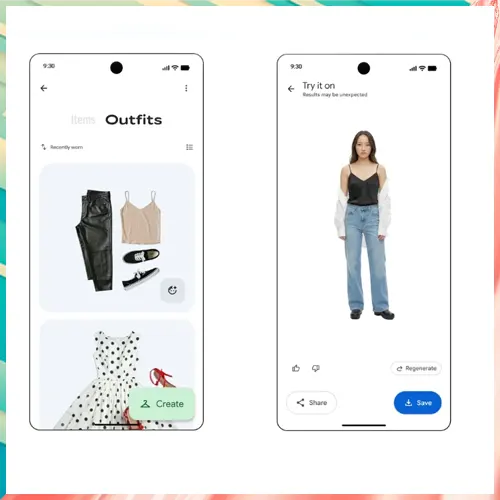
The visual AI landscape continues its rapid evolution, bringing sophisticated capabilities closer to everyday users and businesses. This week, we're seeing a clear surge in practical AI applications, from virtual try-on features making online shopping more immersive to social media platforms integrating AI directly into content creation workflows. These advancements underscore a pivotal shift: AI is no longer just a backend tool but a front-facing creative partner, reshaping how we interact with images and video.
Virtual Try-On Goes Mainstream: Google Photos & Retail Lead the Charge
The dream of effortlessly "trying on" clothes or accessories online is now firmly embedded in mainstream consumer technology, signaling a significant leap in AI's practical application. Google Photos has rolled out its much-anticipated AI Wardrobe feature, allowing users to virtually try on different outfits directly within their photo library. This isn't just a novelty; it’s a powerful tool that leverages advanced AI to segment clothing items, understand garment draping, and realistically composite them onto a user's body in various poses. The implications are enormous for personal styling, fashion discovery, and even reducing returns in e-commerce.
Beyond personal photo management, the retail sector is vigorously adopting similar virtual try-on technologies. The online eyewear market, for instance, is pioneering sophisticated AI recommendations coupled with virtual try-on capabilities. Customers can now upload a selfie or use their device's camera to see how different frames look on their face, complete with accurate sizing and styling advice. This level of immersion bridges the gap between the physical and digital shopping experience, addressing a major pain point for consumers buying fashion items online. The underlying technology involves complex 3D modeling, real-time rendering, and precise facial recognition, ensuring a highly personalized and accurate simulation. For businesses, this means enhanced customer engagement, reduced cart abandonment rates, and a significant boost in sales confidence. Platforms that can quickly and accurately remove backgrounds from product images and enhance their quality, much like BgRemovit, become indispensable for retailers looking to create the high-fidelity assets required for these advanced virtual try-on systems. The seamless integration of AI-powered virtual try-on is not just a trend; it's becoming a foundational expectation for modern online retail, promising a future where shopping is more intuitive and less prone to guesswork.
Social Platforms Embrace AI-Powered Content Creation
Social media, the ultimate arena for user-generated content, is rapidly integrating AI to empower creators and enhance engagement. Snap Inc. is set to introduce "Snap AI Clips" to Snapchat this year, bringing advanced AI video generation capabilities directly to its massive user base. This move is a game-changer, allowing users to transform simple ideas or short prompts into dynamic video content with unprecedented ease. Imagine typing a sentence and instantly having a shareable video clip, complete with effects and animations, ready for your story. This democratizes video production, lowering the barrier to entry for creative expression and potentially ushering in a new era of highly personalized, AI-assisted content. The competition among social platforms to offer the most intuitive and powerful AI creation tools is heating up, as they vie for user attention and content volume.
Furthermore, the influence of AI extends deeply into image editing workflows for social media. "ChatGPT Photo Editing Prompts" are rapidly trending on platforms like Instagram, demonstrating how users are leveraging large language models to refine and beautify their images. Instead of complex manual adjustments or specialized software knowledge, users are simply prompting AI with descriptions like "make this photo look like a cinematic sci-fi scene" or "give this portrait a warm, vintage aesthetic." The AI then interprets these natural language commands to apply sophisticated edits, filters, and even stylistic transformations. This approach not only simplifies the editing process but also introduces a new realm of creative possibilities, allowing users to experiment with diverse visual styles without extensive technical skills. It highlights a broader trend where AI acts as an intelligent co-pilot for content creation, making advanced visual effects accessible to anyone with a smartphone and a creative idea. The rapid adoption of these AI-driven editing and generation tools on social platforms signals a future where AI is not just an optional feature but an intrinsic part of how we capture, create, and share our digital lives.
ChatGPT Images 2.0's Mixed Global Reception Highlights Market Nuances
The landscape of AI image generation is fiercely competitive, and even major players experience varied success across different markets. TechCrunch reports that "ChatGPT Images 2.0" has become a significant hit in India, but its reception elsewhere has been more subdued. This regional disparity offers valuable insights into the diverse needs and adoption patterns for AI-powered creative tools. In India, a market characterized by a vast, mobile-first user base and a burgeoning creator economy, the accessibility and ease-of-use offered by ChatGPT Images 2.0 likely resonate strongly. The ability to quickly generate aesthetically pleasing or culturally relevant images from simple text prompts, without requiring high-end computing resources or extensive technical knowledge, fits perfectly with the demands of rapid content creation for social media, personal projects, and small businesses in the region.
However, the more muted success in other markets could be attributed to several factors. Established AI image generators like Midjourney and DALL-E have already carved out significant user bases, particularly among professional artists and advanced hobbyists, offering highly specialized features and often superior artistic control. Users in these markets might be less inclined to switch or adopt a new tool unless it offers a truly groundbreaking advantage. Furthermore, the sheer volume of AI image tools available globally means that competition for mindshare is intense. The distinction between a "hit" and a "big winner" often comes down to market penetration, user retention, and the ability to differentiate in a crowded field. This scenario underscores that while AI image generation technology is powerful, its commercial success hinges not just on technical capability but also on strategic market fit, user experience, and the specific cultural and economic contexts of different regions. As AI image generation continues to evolve, understanding these nuanced market dynamics will be crucial for developers aiming for widespread adoption.
Editor's Take
This week's developments paint a clear picture of AI's accelerating integration into our visual world, moving beyond niche applications to become fundamental components of consumer experiences and creative workflows. Virtual try-on solutions, whether in Google Photos or online retail, are not merely conveniences; they are transformative tools that enhance user confidence and streamline commerce. Meanwhile, the rapid embrace of AI-powered content creation on social media, from Snapchat's video generation to ChatGPT's prompt-driven photo editing, signifies a democratization of creative power. This empowers millions to produce high-quality visual content with unprecedented ease, fundamentally altering how we express ourselves and engage with digital platforms.
However, the varied global reception of tools like ChatGPT Images 2.0 reminds us that "one size fits all" rarely applies in the diverse global tech landscape. Success demands a deep understanding of regional needs, existing market saturation, and cultural nuances. As AI continues to mature, we can expect even more sophisticated, context-aware, and personalized visual AI experiences. The challenge for innovators will be to balance cutting-edge capabilities with intuitive design and ethical considerations, ensuring these powerful tools genuinely enhance, rather than complicate, our digital lives.
Sources
- Snap AI Clips Makes It’s Way Into Snapchat This Year - Women Love Techopen_in_new
- Google Photos adds AI Wardrobe feature with virtual try-on - varindia.comopen_in_new
- ChatGPT Photo Editing Prompts: Trending Instagram Prompts to Turn Your Images Aesthetic - Jagran Joshopen_in_new
- Virtual try-on, AI recommendations, and 100-day returns: how online eyewear got smarter than your local optician - Retail Technology Innovation Hub