The quick answer? The absolute best cards to hide in Cheater's Table are the Draw 50, the Cadillac, and the Swap card. Stashing these high-impact cards up your sleeve protects them from immediate counters like the Card Shield, allowing you to drop a game-ending penalty when an opponent is down to their final life.
If you want to survive Lagari’s chaotic mafia-noir card game, you need to know the best cards to hide Cheater's Table. Released in May 2026, Cheater's Table takes the familiar color-matching shedding mechanics of Uno and injects them with a lethal dose of social deduction, bluffing, and outright fraud. At this table, cheating isn't just allowed; it is a core, mandated mechanic. But getting caught carries a heavy price. Every time you press the Cheat button to secretly reach for a stashed card, you risk interrogation. If an opponent challenges you and guesses the correct hiding spot on your character's body, you lose one of your precious lives, forfeit the card, and lose your turn.
Because the penalty for a failed cheat is so severe, you cannot afford to risk your neck for a low-value play like a standard Skip or Reverse. You must reserve your hidden slots for game-breaking power cards.
Why Choosing the Best Cards to Hide Cheater's Table Changes Everything
To understand why certain cards belong up your sleeve rather than in your active hand, you have to look at the game's brutal life system. Each player starts with a set number of lives. Whenever any player empties their hand, everyone else at the table loses one life. Run out of lives, and you are permanently eliminated from the lobby.
At the start of the game, you are dealt powerful hidden cheat cards. These do not sit in your visible hand count; instead, they are virtually tucked into different concealment zones on your character model—the lapel, the fedora band, the forearm sleeve. Other players cannot see them, and they cannot be affected by hand-clearing effects like the Acid King.
When you decide to play one, you trigger a subtle animation—like scratching your arm. This is the tell. Opponents have a brief window to challenge you. If they call your bluff, they must interrogate a specific spot on your body. Guess right, and you take damage. Guess wrong, and the challenger takes a penalty while you successfully deploy the card.
Because successful cheats make the remaining safe spots on your body fewer and more obvious, every subsequent cheat becomes exponentially more dangerous. You are burning a limited resource (un-interrogated hiding spots) every time you reach for a card. Therefore, the mathematics of the game dictate that you only cheat when the payoff guarantees a massive swing in momentum or directly eliminates a rival.
The S-Tier: The Absolute Best Cards to Hide Cheater's Table
The S-Tier represents cards that are so devastating they can single-handedly win a round or eliminate a player. Playing these from your active hand is risky because opponents can see them coming or counter them. Hiding them ensures they hit with maximum impact.
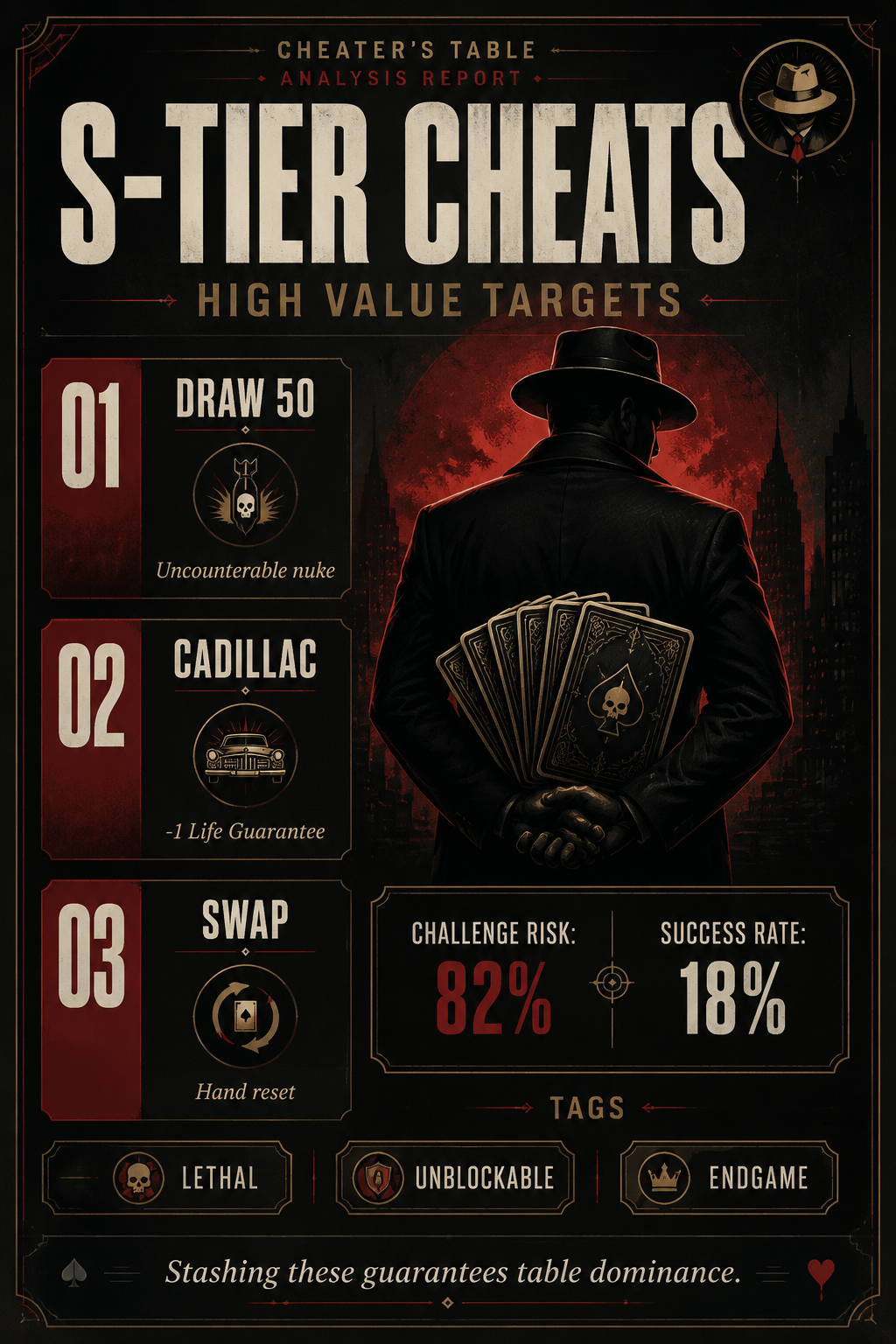
The Draw 50
There are Draw Sevens, and then there is the Draw 50. Forcing the next player to draw 50 cards is an effective death sentence in a game where emptying your hand is the primary win condition. However, if you play a Draw 50 from your visible hand, a skilled opponent holding a Card Shield can deflect the massive draw stack back onto you or the next player.
By keeping the Draw 50 hidden, you bypass the psychological warning. You wait until the target has already burned their Card Shield on a lesser threat, scratch your arm, and drop the nuke. It is uncounterable when timed correctly.
The Cadillac
Cheater's Table features a literal assassination card. The Cadillac allows you to pick an opponent and drop a car on top of them, instantly costing them one life. It bypasses the hand-emptying requirement entirely. Hiding the Cadillac is the ultimate endgame strategy. When a rival is sitting on their final life and is about to go out, you bypass the normal turn order, trigger your cheat, and eliminate them on the spot.
The Swap
Sometimes, despite your best efforts, you get hit with a Draw Seven or an Acid King, and your hand balloons to 20+ cards. You are dead in the water. The Swap card allows you to trade hands with another player. Hiding a Swap card is your emergency ripcord. You wait until an opponent proudly announces they are down to their final card, trigger your hidden Swap, and steal their imminent victory while handing them your bloated mess of a hand.
Situational Power: More of the Best Cards to Hide Cheater's Table
While the S-Tier cards are universally dominant, the A-Tier cards are highly situational. They require precise timing and table awareness to execute properly, but when they hit, they hit hard.
The Bomb and Hot Potato Combo
The Bomb card forces a selected opponent to play rapidly against a ticking timer. If they cannot play a valid card or pawn the bomb off before the timer expires, they lose a life. In overtime, the timer ticks down even faster.
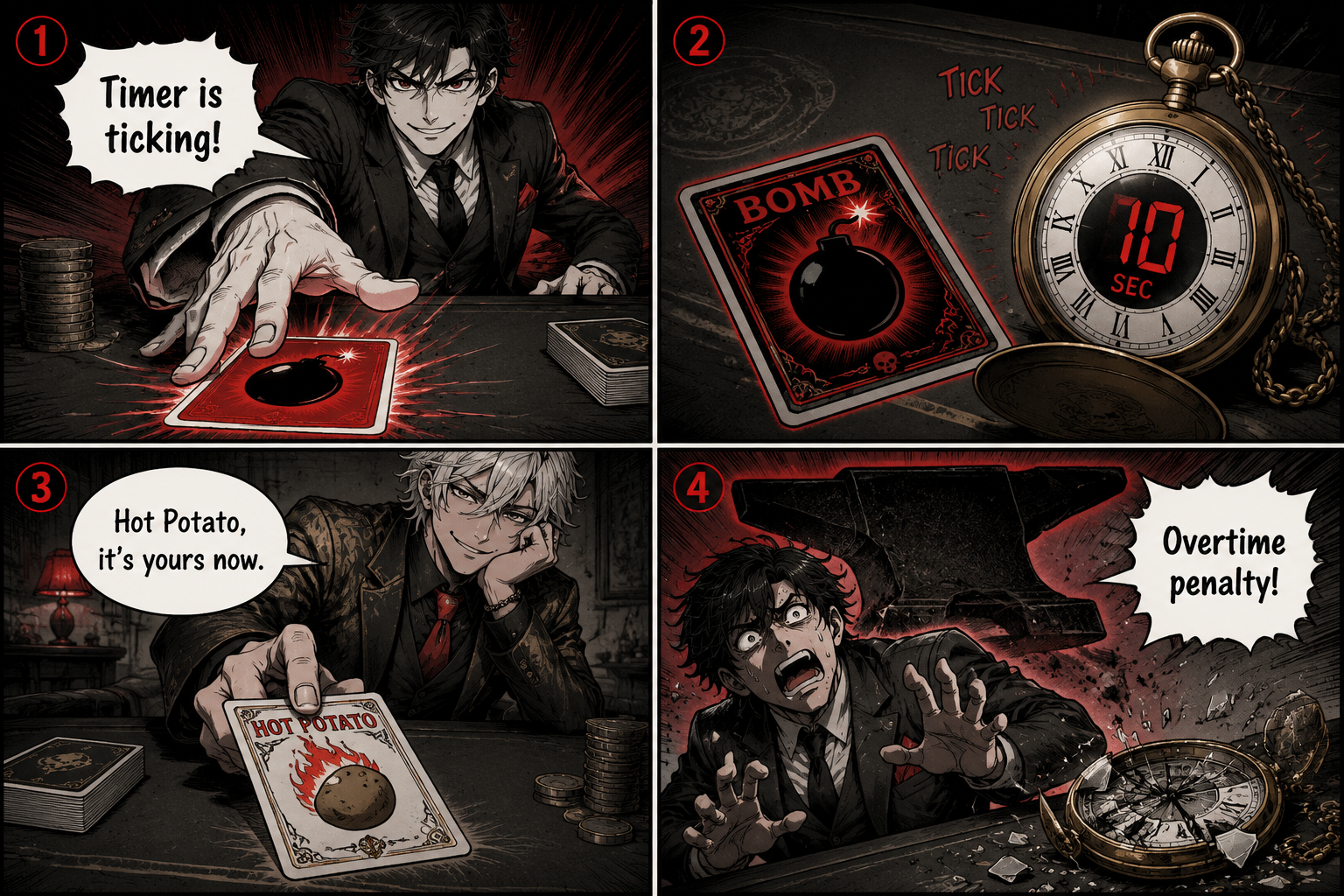
Hiding a Hot Potato card is the definitive counter-play to the Bomb. The Hot Potato causes an active bomb to rotate to another player. If you keep a Hot Potato up your sleeve, you can intentionally bait an opponent into bombing you. You let the timer tick down to the absolute last second, maximizing the panic, then cheat out the Hot Potato. The bomb passes to the next player with almost zero time left on the clock, guaranteeing they take the life penalty.
The Acid King
The Acid King is a wild card that strips all cards of a particular color from your hand and changes the active play pile to that color. It is a fantastic hand-reduction tool. Hiding the Acid King is useful when you are dealt a "dead hand"—a massive cluster of a single color that you cannot easily shed. By keeping the Acid King hidden, you protect it from being stolen by a Swap card, saving it for the exact moment you need to dump half your hand in a single turn.
| Card Name | Effect | Best Phase to Hide | Risk of Challenge |
|---|---|---|---|
| Draw 50 | Forces next player to draw 50 | Mid-Game | Very High |
| Cadillac | Drops a car, opponent loses 1 life | Endgame | High |
| Swap | Swaps hand with another player | Late-Game | Medium |
| Acid King | Clears and changes a color | Early-Game | Low |
| Hot Potato | Passes the Bomb timer | Overtime | Medium |
The Bad Apple Strategy: Baiting the Challenge
You cannot discuss the best cards to hide Cheater's Table without addressing the trap system. If you only ever hide high-value S-Tier cards, your opponents will quickly learn that every time you scratch your arm, you are reaching for a nuke. They will challenge you aggressively, and you will lose lives.
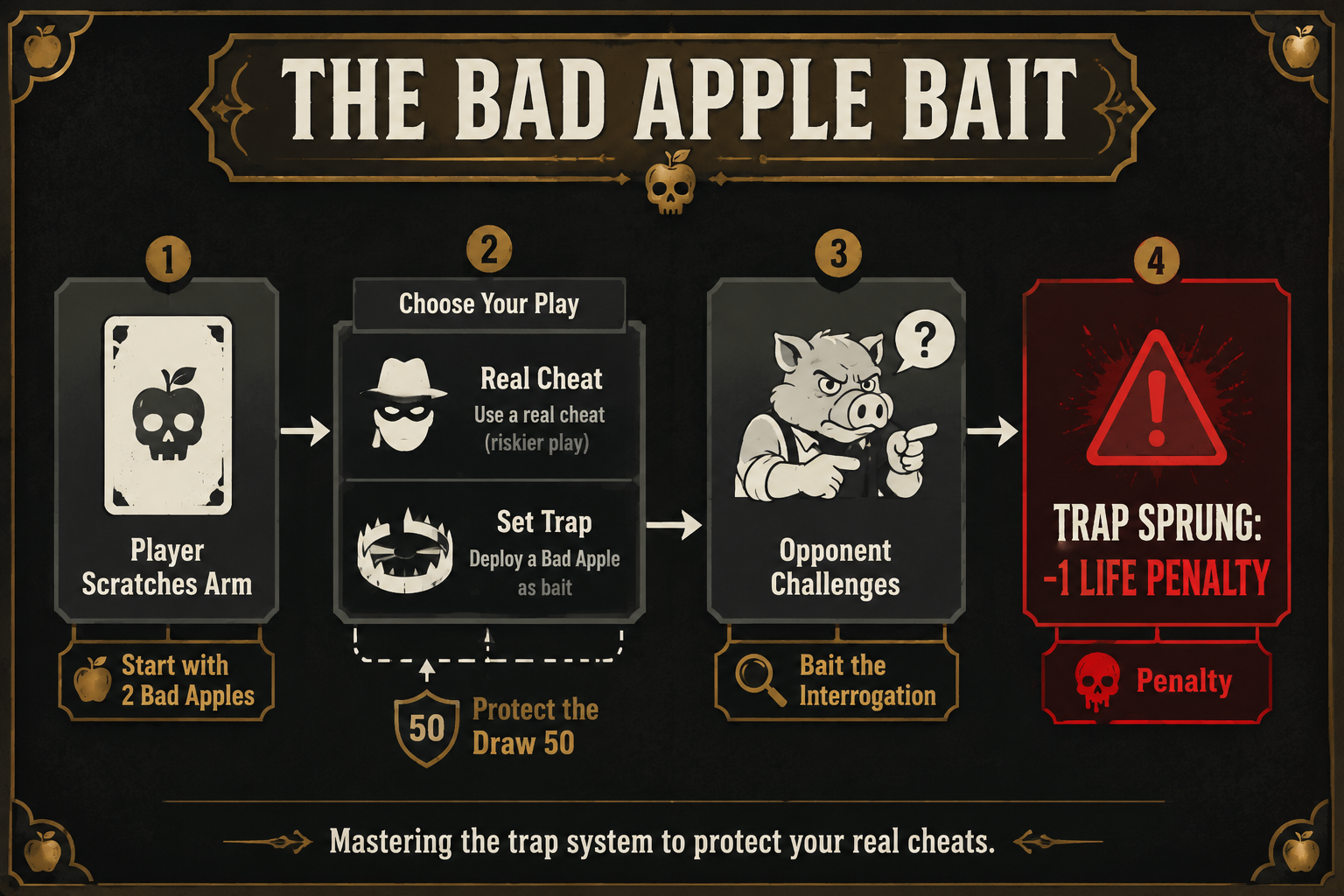
To protect your real cheats, you must utilize the Bad Apple. Every player starts with two Bad Apples. These are not playable cards; they are traps. You can assign a Bad Apple to one of your hidden spots. On your turn, you can pretend to cheat by reaching for that spot.
This is the ultimate bait. You intentionally act suspicious. You hesitate. You scratch your arm right when the table expects you to drop a Draw 50. An eager opponent slams the challenge button and interrogates your lapel. Instead of finding a Cadillac, they find the Bad Apple. The trap springs, and the challenger takes a severe penalty.
Establishing a pattern of Bad Apple baits early in the match terrifies the table. Once opponents have been burned by a trap, they become hesitant to press the challenge button. That hesitation is exactly what you need to safely deploy your real S-Tier cards in the late game.
Managing the Milk Card Endgame
There is one final catch to Lagari's chaotic design: the Milk Card. At the start of the game, a final card is placed face down on the table. Before you can truly finish the game and claim victory, you must discard the Milk Card.
This endgame requirement completely alters the math of hiding cards. If you have successfully hidden a Swap card, the Milk Card phase is the perfect time to use it. When an opponent successfully discards their hand and reaches for the Milk Card, you trigger the Swap. You steal their empty hand (leaving you with only the Milk Card to play) and give them your remaining cards.
FAQ: Finding the Best Cards to Hide Cheater's Table
What happens if I am caught hiding a Draw 50? If an opponent challenges you and correctly identifies the spot where you hid your Draw 50, you immediately lose 1 life, the Draw 50 is discarded without taking effect, and your turn ends. The risk is massive, which is why baiting with Bad Apples first is mandatory.
Can I hide the Milk Card? No. The Milk Card is a static, face-down objective placed on the table at the start of the match. It cannot be picked up, hidden, or swapped until a player has completely emptied their active hand.
Is it better to hide a Draw Seven or play it normally? Play it normally. A Draw Seven is a strong card, but it is not worth burning one of your limited safe hiding spots or risking a 1-life penalty. Save your hidden slots for unrecoverable nukes like the Draw 50 or the Cadillac.
How many cards can I hide at once? You are limited by the number of concealment zones on your character model (typically 3 to 4 spots, such as the hat, lapel, and sleeves). However, filling every spot with a cheat card leaves no room for Bad Apple traps, making you highly vulnerable to interrogations.