Welcome to the ultimate customer requests guide Puni the Florist players need to master Earthquack Games’ breakout cozy shop simulator. In this charming indie title, you step into the shoes of Puni, a former office worker who is unexpectedly bestowed a magical flower shop by a giant, talkative fly fairy. Over the course of a 12-day story mode, you must navigate a surprisingly deep floral arrangement system to satisfy the quirky townsfolk who wander through your doors. Winning them over requires more than just throwing petals into a vase; you must decipher vague moods, utilize the language of flowers, and physically manipulate stems to create structural masterpieces. If you are struggling to figure out what Mr. Ken considers "cool-toned" or how to construct a dinosaur out of hydrangeas, this comprehensive breakdown will ensure every bouquet you send out earns top marks.

Essential Mechanics for Your Customer Requests Guide Puni the Florist
Before diving into specific client orders, any reliable customer requests guide Puni the Florist offers must first dissect the workbench mechanics. The game provides a highly tactile, physics-adjacent arrangement system that rewards creativity while imposing a few strict physical limitations. When a customer hands you a sketch or a vague prompt, you must translate that into a 3D arrangement using four primary categories: Focal flowers, Greenery, Filler flowers, and Props.
The true challenge lies in the manipulation tools. You are granted immense freedom with your Focal flowers. You can bend the main stems to create dynamic, sweeping shapes that break out of the standard vertical alignment. If a stem looks too cluttered, you can actively cut leaves off the main stalk to create negative space, preventing the arrangement from looking like a chaotic bush. The interface allows for precise manipulation: you can click and drag to adjust the height, or use the scroll wheel to push flowers deeper into the arrangement or pull them to the forefront. This Z-axis manipulation is what separates Puni the Florist from flatter, 2D simulation games. Placing large, dark-colored leaves at the back of the arrangement creates a shadow effect that makes the brightly colored Focal flowers pop.
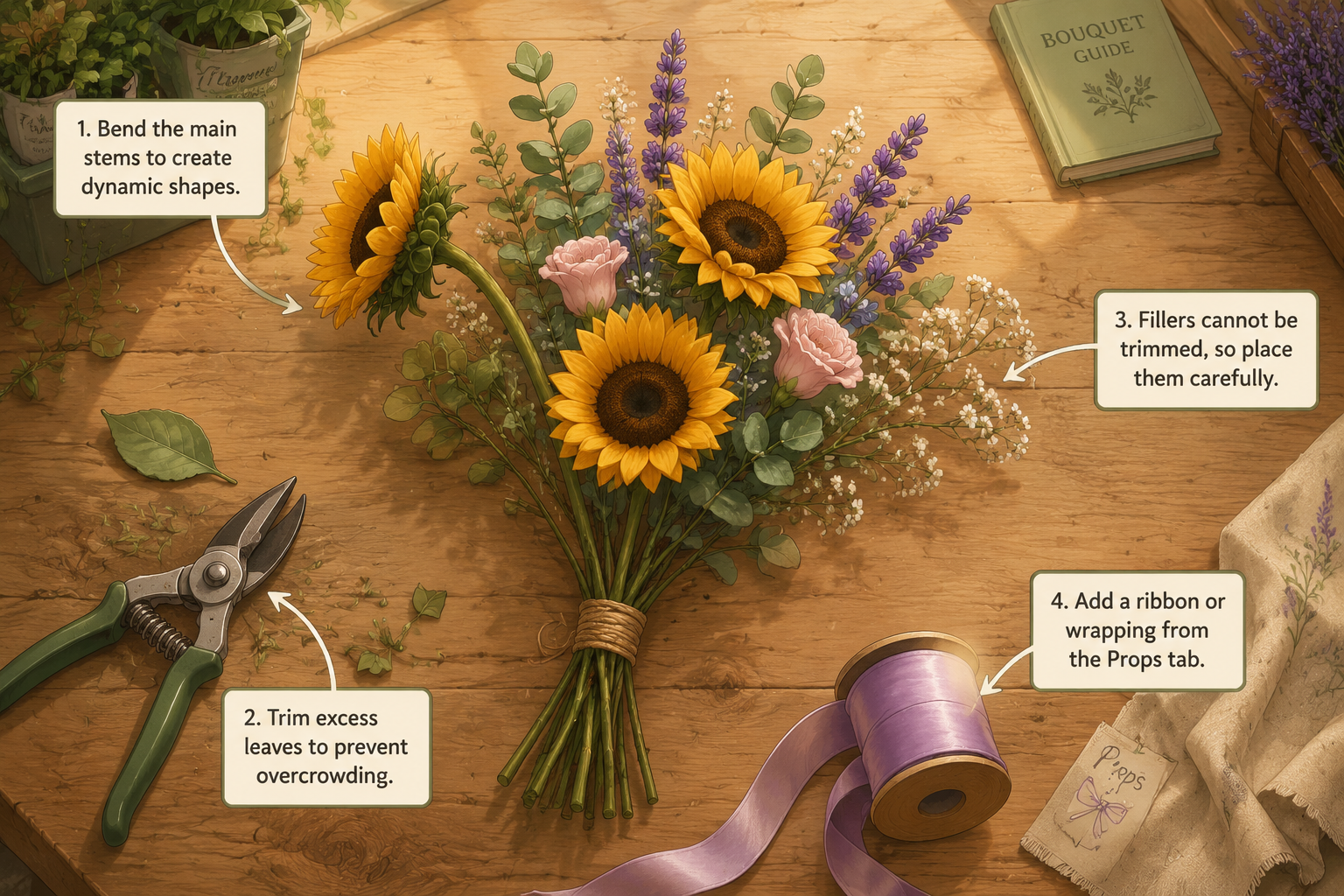
However, the game introduces a deliberate mechanical friction with Filler flowers. Unlike your primary blooms, filler objects cannot be bent, nor can their stems be snipped. This is a crucial detail that many new players overlook. If you attempt to build a perfectly rounded, compact bouquet, you will quickly find that rigid filler stems stick out at awkward angles, often resulting in a blocky, rectangular shape. To master the requests, you must learn to angle your main flowers around the rigid fillers, using Greenery to mask the straight lines of the uncut stems. Finally, no bouquet is complete without Props—selecting the right ribbon or wrapping paper from the Props tab not only ties the visual palette together but is often the unstated finishing touch that elevates a customer's satisfaction.
Story Mode: Early-Game Customer Requests Guide Puni the Florist
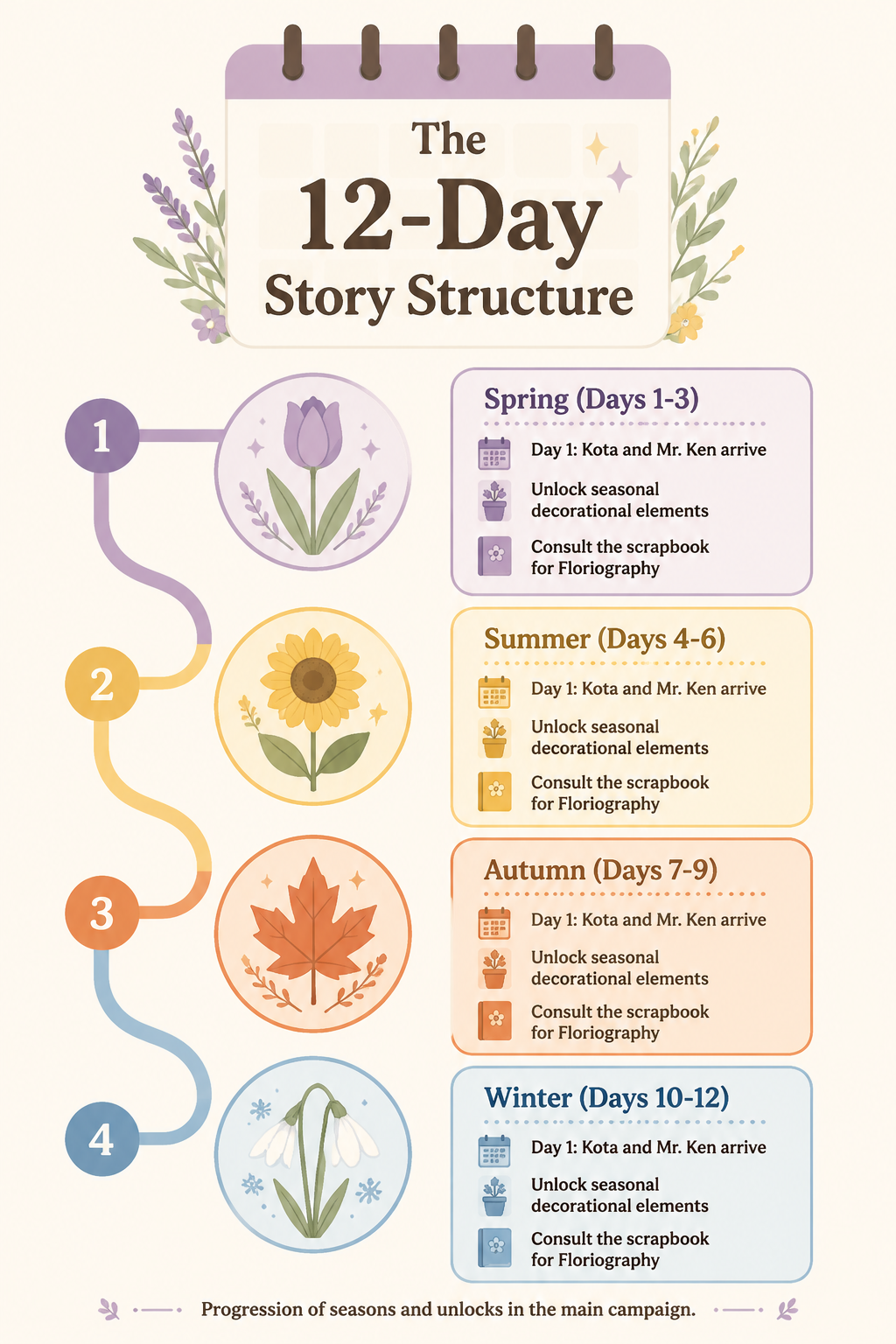
The campaign of Puni the Florist is a tight, narrative-driven experience spanning exactly 12 in-game days, divided equally across the four seasons. Spring (Days 1 through 3) serves as your initiation. During this period, the requests are highly literal, designed to teach you the UI and the basic rules of color matching.
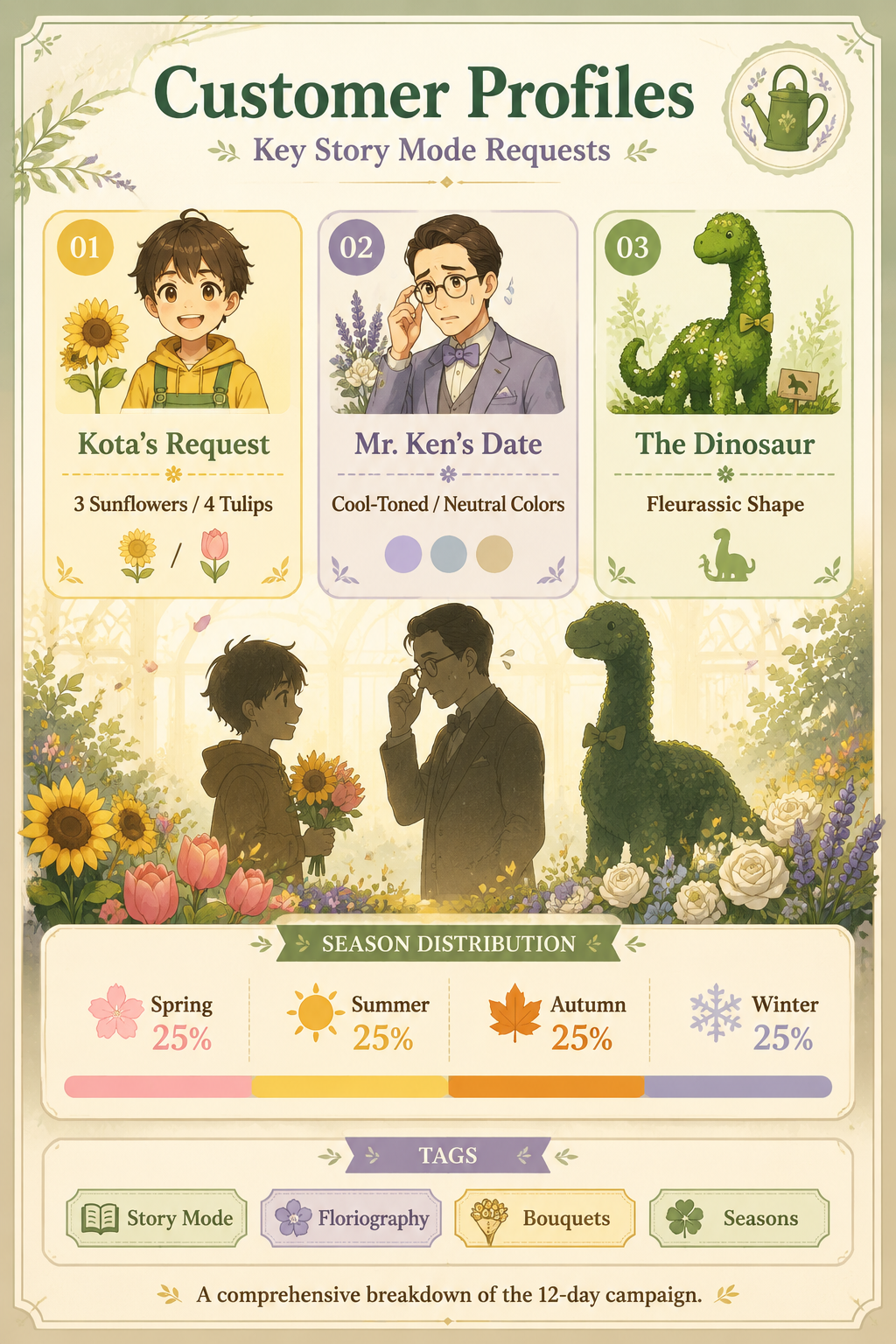
Day 1 acts as an extension of the tutorial, introducing you to the pacing of the shop. You will face four distinct customers, but two stand out as the primary learning hurdles: Kota and Mr. Ken.
Kota is an energetic young boy who doesn't leave much to the imagination. He brings you a literal sketch of what he wants. His request demands exactly three Sunflowers and four Tulips as the Focal flowers. While the game gives you the freedom to place them however you like, hitting this exact numerical requirement is mandatory. Once the focal points are placed, you are expected to pad the arrangement with appropriate Greenery and Filler flowers, capping it off with a ribbon before hitting "Send."
Mr. Ken, on the other hand, introduces the concept of abstract color requests. A nervous man preparing for a date, he asks for a "Cool-Toned" bouquet with "Neutral Colors." This requires you to step away from the vibrant yellows and reds of Kota's order and delve into your inventory for blues, soft purples, and whites. Hydrangeas and pale roses are your best friends here. By adhering strictly to the cool-toned palette, you successfully fulfill his request and unlock further seasonal decorational elements for your shop.
On Day 2 and Day 3 of Spring, the training wheels come off slightly. You are introduced to customers who request bouquets for specific events rather than just listing colors. For instance, a customer might need a centerpiece for a casual family dinner. Here, the game evaluates not just the flowers chosen, but the container. A casual dinner calls for a rustic wicker basket or a simple glass vase, rather than an ornate, gold-trimmed ceramic pot. You also learn about spatial limits; you cannot simply cram fifty premium roses into a single wrap. The physical space of the bouquet wrap acts as a natural limit, forcing you to balance high-impact Focal flowers with cheaper, space-filling Greenery.
Mid-to-Late Game Challenges and the Infamous Dinosaur
As the game transitions into Summer (Days 4-6) and Autumn (Days 7-9), the townsfolk become significantly more demanding, and their prompts shift from literal instructions to creative puzzles. You are no longer just matching colors; you are matching shapes and concepts.
Summer introduces the heat mechanic, conceptually speaking, where customers ask for bright, sun-drenched palettes. You will unlock Sunflowers, Marigolds, and bright pink Peonies. The townsfolk start asking for "vibrant" and "energetic" arrangements.
Autumn is where the mood shifts. The color palette of the game turns to burnt oranges, deep reds, and browns. Customers begin requesting bouquets for somber occasions—farewells, autumnal equinox celebrations, and apologies. The most notorious request in the game—and a frequent stumbling block for players—usually appears around this mid-game transition. A quirky customer will enter the shop and ask you to craft an arrangement in the literal shape of a prehistoric creature.
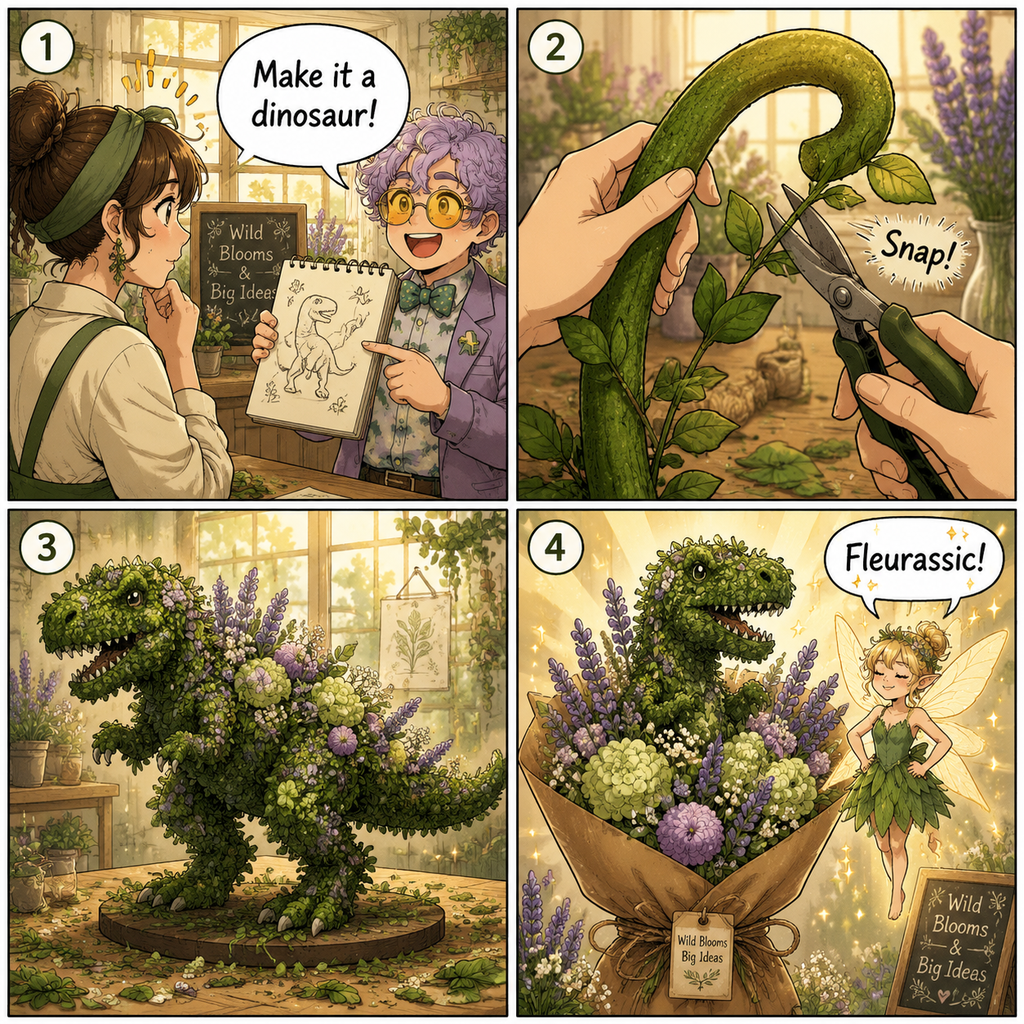
The game prompts you to name your creation (the community favorite being "Fleurassic"). Fulfilling this Dinosaur Bouquet requires absolute mastery of the bending mechanic. You must use sturdy Greenery to form the structural spine and tail of the T-Rex, while carefully bending smaller Focal flowers to act as the head and legs. Because you cannot trim the stems of Filler flowers, you must avoid them entirely for this specific build, as they will ruin the silhouette of your leafy beast.
By Winter (Days 10-12), the requests culminate in emotionally resonant, story-heavy orders that test everything you've learned. The game unlocks its full suite of flowers, meaning your inventory is massive, and finding the exact right bloom requires careful reading of the customer's dialogue. A character might ask for a bouquet that "represents our journey together." To solve this, you have to remember the flowers you gave them back in Spring and Summer, combining those historical blooms into a single, cohesive Winter arrangement.
Decoding Vague Orders: Advanced Customer Requests Guide Puni the Florist
To truly excel, an advanced customer requests guide Puni the Florist must address the game's implementation of Floriography—the Victorian language of flowers. As you progress, customers will stop asking for specific colors and start asking for specific feelings. A grieving character might ask for "comfort," while a hopeful entrepreneur might ask for "new beginnings."
This is where your in-game scrapbook becomes your most valuable tool. The scrapbook acts as an encyclopedia, logging the hidden meanings behind every flower you unlock.
| Flower Type | In-Game Color Variants | Floriography Meaning (Scrapbook) | Ideal Customer Request Scenario |
|---|---|---|---|
| Tulip | Red, White, Yellow | Apology, Peaceful Resolution, Sunshine | Resolving town disputes, cheerful gifts |
| Sunflower | Yellow, Dark Center | Loyalty, Adoration, Youthful Energy | Kota's requests, energetic prompts |
| Hydrangea | Blue, Purple, White | Heartfelt Emotion, Understanding | Mr. Ken's date, cool-toned requirements |
| Rose | Red, Pink, White | Deep Love, Romance, Purity | Valentine's events, anniversary orders |
| Marigold | Orange, Yellow | Warmth, Creativity, Remembrance | Autumn festivals, farewell bouquets |
| Peony | Pink, White | Prosperity, Good Fortune, Bashfulness | Grand openings, shy confessions |
When a customer gives a vague prompt, immediately cross-reference their dialogue with your scrapbook. If they mention wanting to apologize to a friend, stuffing the bouquet with red roses will result in a failed or low-rated interaction, regardless of how beautifully arranged the stems are. You must select the white tulips.
Furthermore, players must heed a critical UI warning: never travel while in the middle of a design. The game does not auto-save your workbench state if you leave the shop interface to check the town map or interact with the fairy boss. Traveling will instantly delete your current arrangement, forcing you to start from scratch. Always finalize your design and hit "Send" before stepping away from the counter.
Frequently Asked Questions (FAQ)
How many days is the story mode in Puni the Florist? The main campaign is exactly 12 in-game days long. These days are divided into four seasons: Spring (Days 1-3), Summer (Days 4-6), Autumn (Days 7-9), and Winter (Days 10-12). Each day brings roughly 3 to 4 unique customer requests.
Can I cut the stems of filler flowers? No. While the game allows you to bend main stems and trim leaves off your Focal flowers, Filler flowers are entirely rigid. You cannot bend them or cut their stems, which means you must place them strategically to avoid giving your bouquet an unintended blocky or rectangular shape.
What is the best way to fulfill Mr. Ken's request on Day 1? Mr. Ken asks for a "Cool-Toned" bouquet with "Neutral Colors." To fulfill this perfectly, ignore warm colors like red, orange, and yellow. Instead, use blue, purple, and white flowers (like blue hydrangeas or white lilies), paired with standard green foliage and a neutral-colored ribbon.
What happens if I leave the shop while making a bouquet? You will lose your progress. The game issues a specific warning that traveling in the middle of a design will delete what you have put together so far. Always complete your customer's request and hit "Send" before exploring the map.
Puni the Florist masks a highly technical puzzle game behind a cozy, pastel-drenched aesthetic. Mastering the shop means looking past the cute fairy dialogue and treating every customer order as a structural and thematic challenge. By memorizing the floriography, respecting the rigidity of your filler stems, and meticulously following the color theory rules, you transform from a confused office worker into a master florist.
Sources
- Earthquack Games Official Press Kit & Launch Trailer (June 2026)
- Into Indie Games: Puni the Florist Walkthrough - All Story Mode Requests
- Steam Community Guides and Player Reviews for Puni the Florist
- Reddit r/cozygames Community Discussions