Auto-battlers are won in the shop, not the arena. Lucha Chess strips away the convoluted interest mechanics of its genre rivals and hands you a flat, unforgiving stipend: 10 gold per battle. It sounds simple, but that fixed income is a psychological trap. Players blow their purse chasing a three-star Red Devil, only to get steamrolled by the Sugar Skulls in the mid-game because their roster size is too small to compete. If you want to survive the Rock Band final boss, you need a flawless gold economy guide Lucha Chess strategy. This isn't about getting lucky with the random number generator; it's about weaponizing your post-battle shop decisions.
In this comprehensive breakdown, we are going to analyze the exact mathematics of the 10-gold drip, when you should aggressively reroll, and how to prioritize your purchases between units, relics, and roster expansions. Step into the ring, because your financial discipline is about to be tested.

The Foundation of Our Gold Economy Guide Lucha Chess: The 10-Gold Drip
Unlike Teamfight Tactics or Dota Underlords, where hoarding 50 gold nets you massive passive interest, Lucha Chess forces a drastically different kind of discipline. You receive exactly 10 gold after every single battle. There is no banking for interest. There is only purchasing power and opportunity cost. Every coin sitting in your treasury is a coin not actively defending your health pool against the Ninjas' evasion tactics or the Skeleton undead swarms.
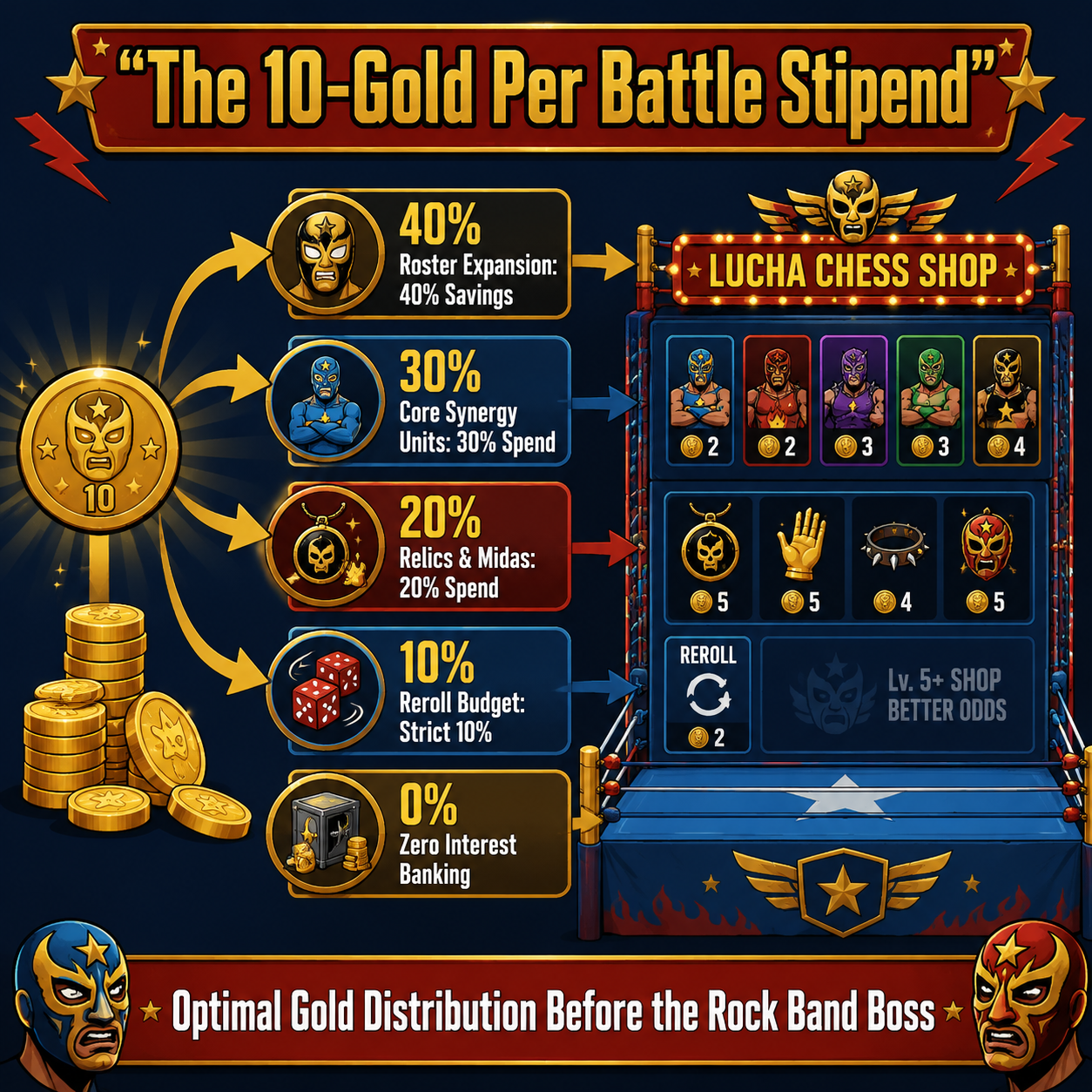
This flat income creates a unique tempo. Because you cannot snowball your economy through hoarding, the player who spends their 10 gold most efficiently each round will always have the strongest board. The shop presents a tantalizing array of options: individual units ranging from 1 to 4 gold, powerful consumables, permanent relics, and the crucial "Expand Team Size" button.
Saving for a roster expansion is the most grueling economic test in the game. If expanding your team from four to five units costs 20 gold, you are forced to float two full rounds of income while your board remains completely static. During those two rounds, you will take damage. The core of mastering the 10-gold drip is calculating exactly how much health you can afford to lose while your purse recovers.
- Rounds 1-3: Buy every 1-gold unit you see to establish a wide bench. Do not reroll.
- Rounds 4-7: Begin saving for your first major roster expansion. Only buy essential synergy units like the Necromancer.
- Rounds 8+: Transition into aggressive spending to counter specific mid-game threats like the Sugar Skulls.
Reroll Math: A Crucial Chapter in This Gold Economy Guide Lucha Chess
The reroll button is the ultimate run-killer in Lucha Chess. When you are staring down a brutal mid-game wave and you are exactly one unit away from a 3-star Queen Bee, spending gold to refresh the shop feels entirely justified. It rarely is.
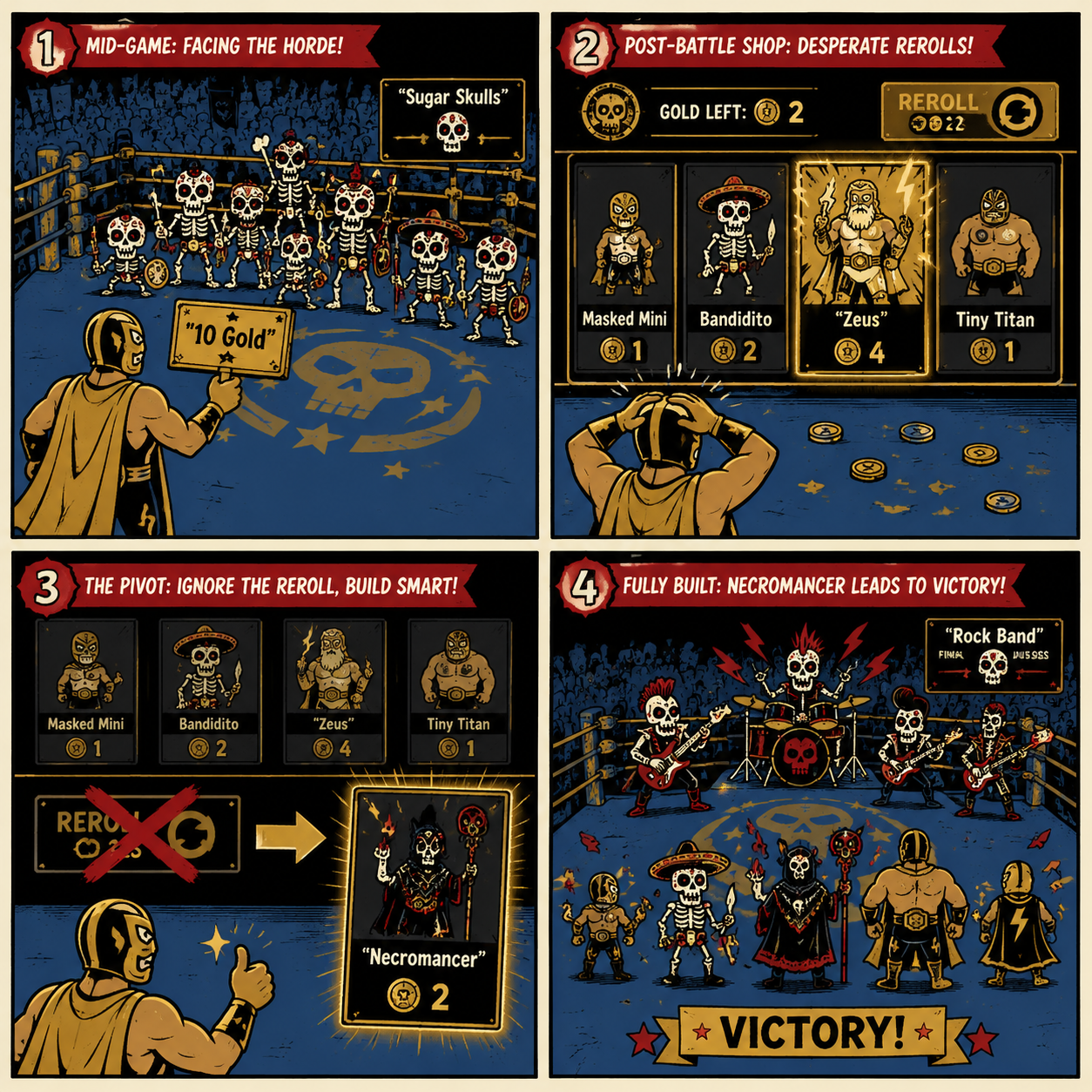
Let's break down the reroll math. Assuming a standard cost of 2 gold per reroll, hitting that button five times wipes your entire round's income. If you start the post-battle phase with your 10-gold stipend and immediately reroll twice, you are down to 6 gold. Suddenly, if the 4-gold Zeus finally appears in the shop, you can barely afford him, leaving you with 2 gold—not enough to buy a supporting unit or a cheap consumable to survive the next round.
We advocate for the "Rule of Two": Never roll more than twice per shop phase unless you are on the brink of lethal damage.
Furthermore, you must understand the shop pool probabilities. Searching for a high-tier unit like Cupid when your player level (or roster size) is low is statistically disastrous. Your 10 gold is much better spent on guaranteed power—buying a relic, expanding the roster, or purchasing a 2-star mid-tier unit like the Red Devil to anchor your frontline. Only roll when you have multiple "outs" (i.e., when there are three or four different units that could meaningfully upgrade your board).
Mid-Game Shop Priorities: Units, Relics, and Roster Expansion
When the post-battle shop opens, you have roughly sixty seconds to allocate your 10 gold. Having a strict priority list prevents panic buying.
Priority 1: Roster Expansion In an auto-battler where synergies dictate the meta, fielding an extra unit is the largest power spike available. Going from a 4-unit board to a 5-unit board allows you to splash in a standalone powerhouse like Zeus, or complete a 3-piece synergy that grants your entire team lifesteal. If the expansion costs 20 or 30 gold, you must plan three rounds ahead, accepting that your board will temporarily stagnate.
Priority 2: Core Synergy Units Your next priority is securing the units that define your build. If you are running an undead composition, finding a Necromancer is non-negotiable. However, do not buy units just because they are high tier. A 4-gold Huntress is useless if your entire build is focused on magic damage and frontline stalling.
Priority 3: Relics and Consumables Relics offer permanent, scaling power. If you see a relic that synergizes with your primary carry (such as an attack speed boost for the Huntress or a spell damage multiplier for Zeus), it is often worth delaying a roster expansion by one round to secure it. Consumables, on the other hand, are temporary bandaids. Spend your 10 gold on consumables only when you know you are facing a massive threat and need a one-round burst of survivability.
Positioning to Save Gold Believe it or not, where you place your luchadores in the ring directly impacts your economy. If your Red Devil is positioned poorly and gets burst down by the Ninjas before casting his ability, you will take massive player damage. This panic often leads players to desperately reroll in the next shop phase, bleeding their gold dry. By mastering positioning—such as placing the high-health Tank in front of the Huntress to draw aggro—you preserve your health pool. A high health pool is a resource; it allows you to aggressively save your 10 gold for a roster expansion instead of panic-buying consumables.
The Hands of Midas Engine
One of the most fascinating items available in the Lucha Chess post-battle shop is the "Hands of Midas." Introduced as a premium relic, this item completely subverts the standard 10-gold drip by injecting extra capital into your economy.
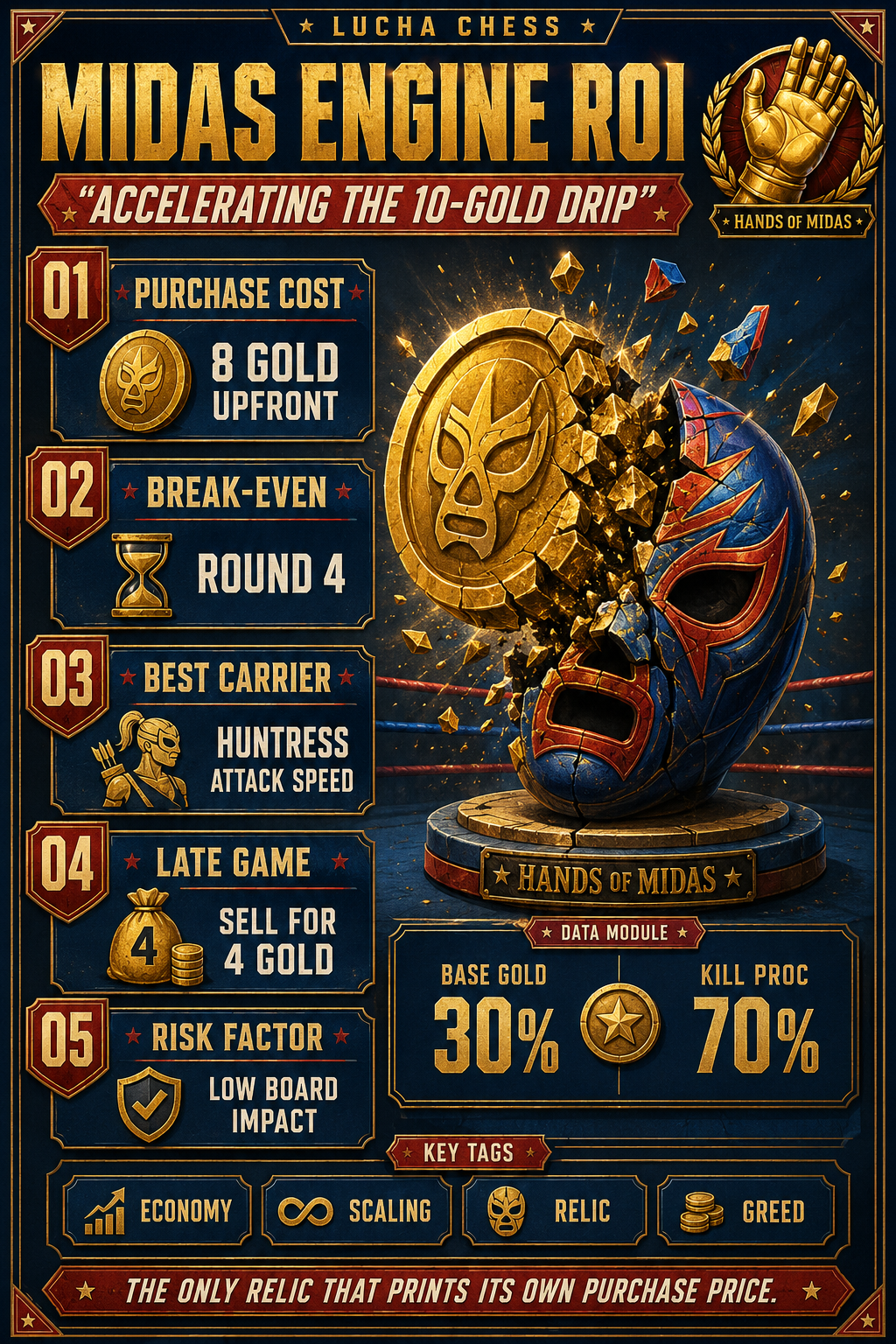
The Hands of Midas essentially acts as an economic engine, but it comes with a steep opportunity cost. If the relic costs 8 gold in the shop, purchasing it consumes 80% of your round's income. You are trading immediate board power for future wealth.
To make the Midas engine work, you must equip it on a unit capable of maximizing its triggers. The Huntress, with her incredibly high innate attack speed, is the premier Midas carrier. The faster a unit attacks or scores takedowns, the faster the relic pays for itself.
The ROI (Return on Investment) Timeline:
- Round of Purchase: You take a massive tempo hit. Your board is objectively weaker than your opponents' because you spent 8 gold on an item with zero combat stats.
- Two Rounds Later: The Midas has generated roughly 4 to 6 extra gold. You are still operating at a net loss.
- Four Rounds Later (Break-Even): The Midas has generated 8 gold. From this point forward, every coin is pure profit, allowing you to easily afford late-game roster expansions and 4-gold units like Zeus and Cupid.
Sell-back Mechanics and the Midas Pivot One often-overlooked aspect of the Hands of Midas is its salvage value. In Lucha Chess, relics and units can typically be sold back to the shop for a fraction of their purchase price. If you bought the Midas for 8 gold in Round 3, and it has generated 14 gold by Round 10, it has already done its job. However, as you approach the Rock Band final boss, that Midas is taking up a valuable relic slot on your Huntress that could be used for a critical damage multiplier. Selling the Midas late in the game refunds a few gold coins—giving you just enough capital for one final, crucial reroll—while freeing up the slot for a combat relic. Knowing exactly when to sell your economic engine is what separates casual players from grandmasters.
Advanced Tactics for the Gold Economy Guide Lucha Chess: Synergy Scaling
Your economy is directly tied to the synergies you choose to pursue. High-cost synergies will drain your 10-gold drip instantly, while budget builds allow you to stockpile wealth for massive late-game pivots.
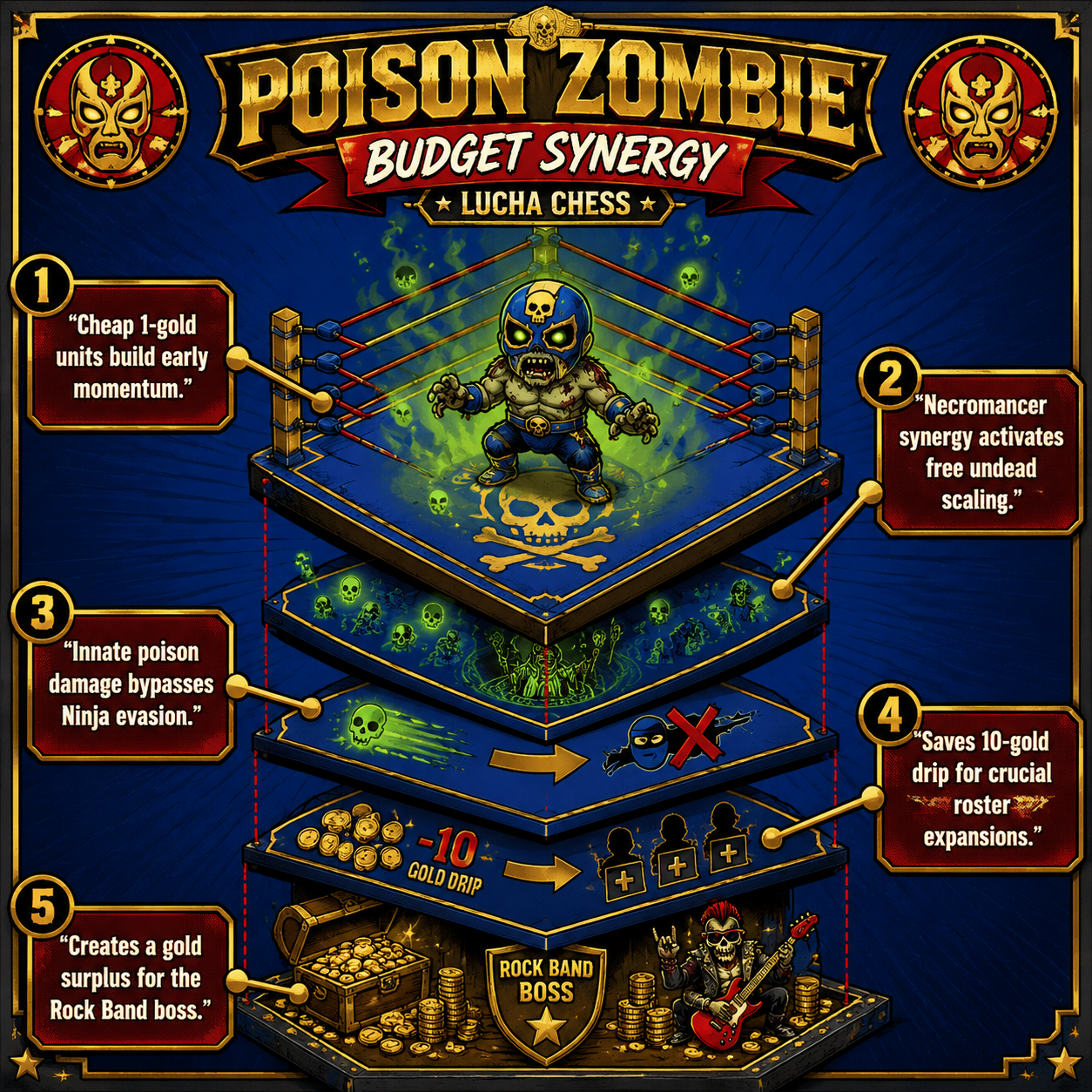
The Budget Build: Poison Zombies The Poison Zombie synergy is the most cost-effective early game strategy in Lucha Chess. The core units (zombies and basic undead) primarily cost 1 or 2 gold. Because their damage comes from innate poison scaling rather than raw stats, you do not need to invest heavily in premium damage relics. Furthermore, pairing them with a single Necromancer activates a powerful undead resurrection loop. This budget frontline allows you to save your 10 gold, easily affording early roster expansions while your opponents bleed their economy dry rerolling for the Red Devil.
The Premium Build: The Pantheon Conversely, trying to force a Pantheon build (featuring Zeus, Cupid, and high-tier mythic units) from round one is a guaranteed way to lose. These units cost 3 to 4 gold each. If you attempt to buy them early, you will never have enough gold left over to expand your team size. The optimal play is to run a cheap, stable board (like Poison Zombies) through the mid-game, stockpile your gold, and then execute a massive transition in the late game once your roster size is maxed out.
The Rock Band Final Boss: The Ultimate Economic Check Everything in your Lucha Chess run culminates in the final encounter against the Rock Band. This boss is essentially an economic gear-check. The Rock Band utilizes screen-wide Area of Effect (AoE) attacks and summons high-health groupies to block your targeting. If your gold economy was poor throughout the run, you will likely enter this fight with a 4-unit or 5-unit board composed of 2-star luchadores. They will be wiped in seconds.
To defeat the Rock Band, you need a 6-unit or 7-unit board. This requires saving 30+ gold for the final roster expansions while simultaneously buying 4-gold carry units like Zeus. You also need premium defensive relics to survive the AoE burst. You only achieve this board state by treating your 10 gold with absolute reverence from Round 1. Every skipped reroll, every calculated loss, and every early Midas proc is a down payment on defeating the Rock Band.
FAQ: Gold Economy Guide Lucha Chess
Should I ever spend all 10 gold on rerolls? No. Spending your entire post-battle stipend on rerolls is a desperation move that almost always results in a loss. Stick to the "Rule of Two" (maximum two rerolls per round) to ensure you always have capital to actually purchase the units you uncover.
Is the Hands of Midas worth buying in late-game shops? Absolutely not. The Hands of Midas requires roughly four rounds of combat to break even on its purchase price. If you are nearing the final boss encounters (like the Rock Band), you must spend your gold on immediate combat stats, not long-term investments.
How do I afford team size expansions when I only get 10 gold per battle? You must plan ahead and "float" your gold. If an expansion costs 20 gold, you need to commit to spending zero gold (or very little) for two consecutive rounds. Mitigate the health loss during these rounds by ensuring your current units are positioned optimally.
Which synergies are the most cost-effective for a tight gold economy? The Poison Zombie and Skeleton undead synergies are incredibly cheap to assemble. They rely on innate status effects (poison) and sheer numbers (resurrections via the Necromancer) rather than expensive stat-boosting relics, leaving your economy healthy for late-game pivots.
Sources
- Lucha Chess Official Steam Store Page and Patch Notes (2026 updates detailing the 10-gold post-battle shop and Hands of Midas).
- SteamDB Lucha Chess Update History and Synergy Logs.
- Community testing and auto-battler economic theorycrafting via Steam Community Discussions.