Wondering exactly how to grow TerraBeast and expand your playable land area? The secret lies in increasing your Tree Score by planting seeds, watering saplings daily, and clearing out invasive Blight crystals with your sword. By nurturing the ecosystem on the back of your wandering companion, you trigger physical land expansions that unlock new biomes and attract rare creatures.
OddFauna: Secret of the Terrabeast is a masterclass in cozy survival. Developed by a husband-and-wife team using photoscanned clay models, the game drops you into the role of an Astor—a tiny explorer living atop a massive, wandering creature. At the start, your living space is little more than a tiny patch of dirt. The core progression loop of the game is terraforming this small patch into a sprawling, thriving ecosystem. But the game doesn't hold your hand. If you have been wandering around aimlessly wondering what to do next, you aren't alone.
This guide breaks down the exact mechanics of ecosystem expansion. We will cover the specific items you need to forage, the daily chores required to sustain your flora, and the economic loops involving characters like Pika that will fund your terraforming empire.
The Lore and Mechanics: What is the TerraBeast?
Before diving into the exact steps of the growth process, it is vital to understand what you are actually standing on. The TerraBeast is not just a static map; it is a gigantic, procedural, living entity. Developer Cliff Mitchell and artist Emma SanCartier designed the game so that every asset—from the roly-poly creatures to the flora—was originally sculpted by hand using real clay before being photoscanned into Unreal Engine.
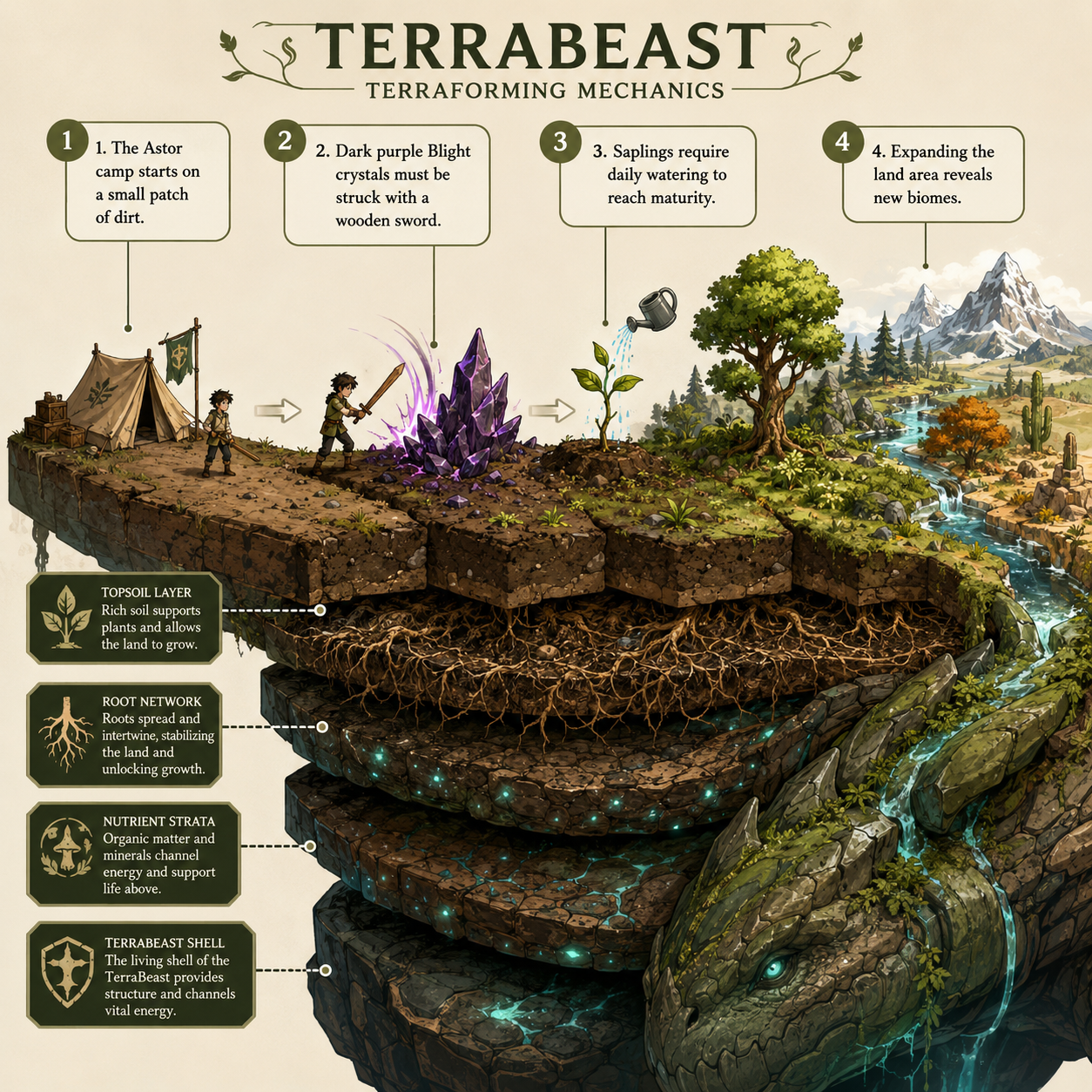
This tactility extends to the gameplay. The ground beneath your Astor's feet responds to your actions. The TerraBeast is wandering through a larger, mysterious world, but its own health is dictated by the micro-ecosystem on its back. If the back is barren and covered in dark purple Blight, the TerraBeast remains small, weak, and restricted. When you introduce life, the creature physically grows, literally expanding the hexagonal grid of your playable area.
Understanding the Core Mechanic: How to Grow TerraBeast
To master how to grow TerraBeast, you must manipulate the game's hidden progression system, which is driven primarily by your "Tree Score."
When you first spawn, the playable area is heavily restricted. The edges of your camp are bordered by dark, corrupted zones or sheer drop-offs. The TerraBeast will only grant you more space when it feels the current space is flourishing.
The Tree Score System
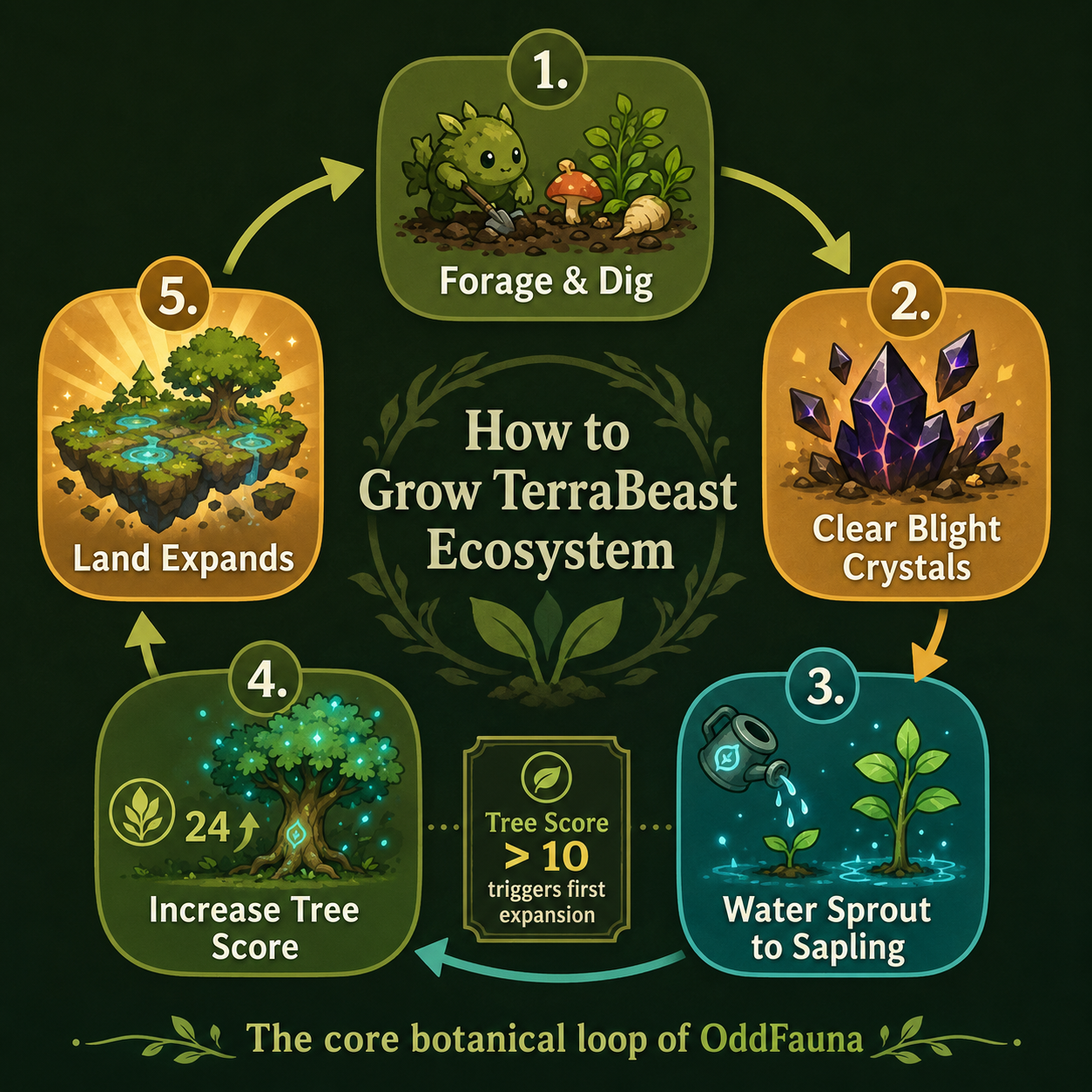
Your primary objective in the early game is to raise your Tree Score. This is a background metric that tracks the number of mature trees currently thriving on your land. The lifecycle of a tree in OddFauna is split into four distinct phases:
- Seeds: Foraged from the environment, shaken from existing foliage, or dug up from glowing treasure spots in the dirt.
- Sprouts: The first fragile stage of growth after planting a seed in healthy soil.
- Saplings: The intermediate stage, requiring consistent care.
- Mature Trees: The final stage. Only mature trees contribute to your overall Tree Score.
You cannot simply plant a seed and walk away to explore. The game enforces a strict daily care loop. You must water and pollinate your saplings to ensure they reach maturity. Skipping watering days will stall their growth, and neglecting them entirely can lead to them withering, drastically delaying your land expansion.
Step-by-Step: How to Grow TerraBeast Through Terraforming
If you want to know how to grow TerraBeast efficiently, you need to treat your daily in-game routine like a strict botanical schedule. The expansion of the land is not time-gated by the calendar; it is effort-gated by your actions.
1. Forage and Dig for Resources
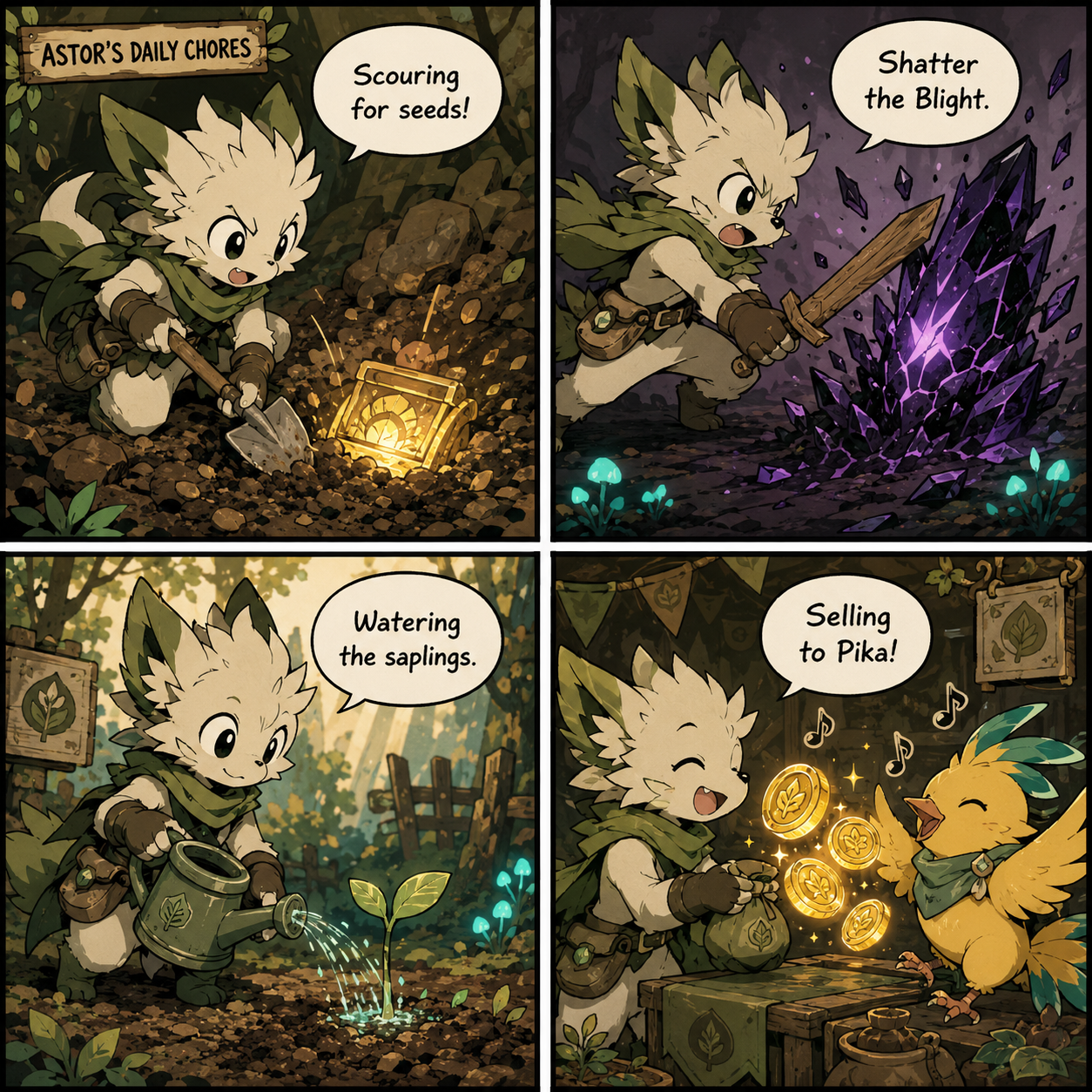
Every morning, your first task should be scouring your existing land for dig spots. Equip your starting tools and unearth glowing treasures, hidden seeds, and basic crafting materials. Because your starting inventory as an Astor is severely limited, you must prioritize seeds and unique flora over common dirt or wood.
2. Clear the Blight Crystals
As you explore the edges of your tiny starting zone, you will notice dark purple Blight crystals encroaching on the healthy soil. These crystals are not just decorative—they actively harm the ecosystem and prevent the TerraBeast from leveling up. You must equip your wooden sword and strike these crystals to shatter them. Not only does this clear space for new crops, but hitting Blight crystals also yields materials that can be used for advanced crafting or sold for currency.
3. Plant, Water, and Pollinate
Designate a specific zone on the TerraBeast's back as your nursery. Plant your tree seeds here. Every in-game day, you must equip your watering can and tend to every single sprout and sapling. Some advanced plants also require active pollination to thrive. Navigating your hotbar efficiently (using the number keys to swap between your sword, watering can, and seeds) is crucial to finishing your chores before your stamina depletes.
4. Manage Your Economy with Pika
As you gather excess materials and treasure, you need an economic outlet. Enter Pika, the dancing bird merchant. Pika serves as your primary link to the game's internal economy. By opening your inventory, scrolling down, and selecting high-value items, you can sell them directly to Pika. The money earned is crucial for buying inventory expansions. Carrying more items means fewer trips back to your storage chests, allowing you to carry more seeds, harvested crops, and terraforming tools simultaneously. This drastically accelerates your growth rate. Do not hoard basic treasures hoping they have a late-game crafting use; in the early hours, liquidating them to Pika to fund your backpack upgrades is the optimal strategy for fast expansion.
Attracting OddFauna: The Second Phase of How to Grow TerraBeast
Once you have established a solid base of flora and your Tree Score hits the required threshold, the magic happens. The TerraBeast will physically expand. The ground will rumble, and new hexagonal tiles of land will emerge from the edges, revealing fresh biomes like dark forest edges or lush meadows. But knowing how to grow TerraBeast is only half the battle; the other half is populating it with wildlife.
The game is called OddFauna for a reason. The whimsical, photoscanned clay creatures wandering the world are not just set dressing—they are integral to your ecosystem's health.
Befriending the Wildlife
When new land appears, it often brings wild OddFauna with it. These roly-poly creatures have specific preferences and behaviors. To befriend them, you must figure out what food they like best.
- Observation: Watch how the creatures interact with the environment. Do they hover near water? Do they sniff at certain flowers? The game does not give you a blatant tutorial on creature diets; you must deduce it from their idle animations.
- Feeding: Drop different types of harvested crops near them. When you find their preferred food, a befriending animation will trigger. If you offer the wrong item, they might ignore it or show a negative reaction, meaning you need to forage for alternative flora.
- Integration: Once befriended, these creatures will hang around your camp. While early demo builds had them mostly standing around, the Early Access release integrates them deeper into the farming loop. Certain creatures can passively benefit your crops by accelerating growth rates, while others might occasionally unearth rare items or unlock unique crafting recipes that you cannot access on your own. Building a diverse roster of friends is just as important as planting trees.
Table: Ecosystem Expansion Milestones
To give you a clear roadmap, here is a comparison of what to expect as you push your ecosystem forward:
| Growth Phase | Required Action | Resulting Expansion |
|---|---|---|
| Phase 1: The Barren Back | Clear initial Blight crystals, plant first 5 seeds. | Unlocks basic crafting recipes and starting tools. |
| Phase 2: The Sprouting Camp | Achieve a Tree Score of 10, water saplings daily. | TerraBeast expands borders; first wild OddFauna appears. |
| Phase 3: The Thriving Grove | Sell treasure to Pika, upgrade inventory, clear outer Blight. | Unlocks secondary biomes (e.g., dark forest edges). |
| Phase 4: The Ecosystem | Befriend 3+ OddFauna species, maintain mature trees. | TerraBeast reaches adolescent size, unlocking advanced terraforming. |
Advanced Strategies for Maximizing Land Area
Many players hit a wall after the first in-game week. They have a small garden, a tiny cottage snapped together from wood, and a few friends, but the land stops expanding. If you are stuck wondering how to push past the early game, you need to optimize your layout and avoid common pitfalls.
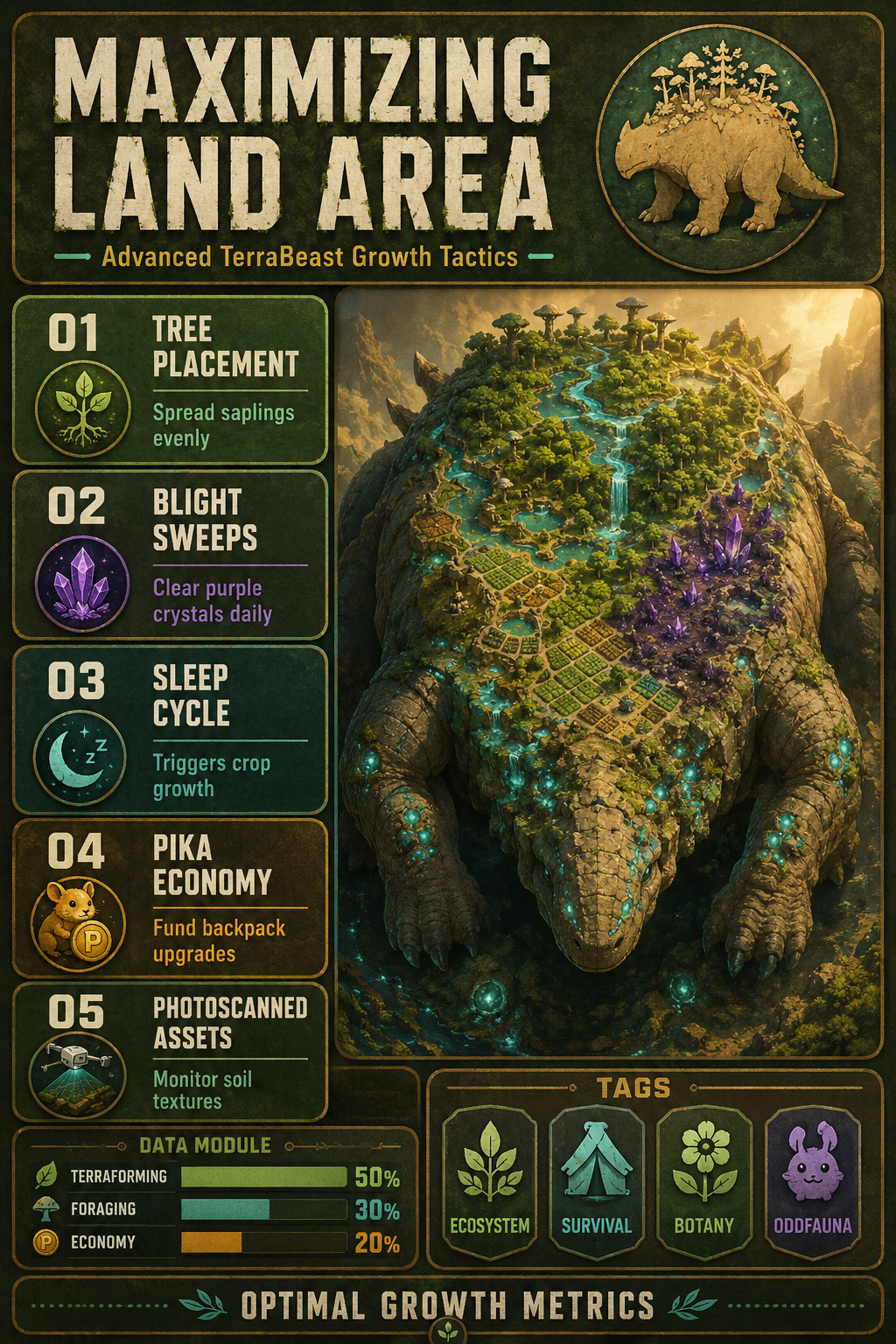
Optimize Your Tree Placement
Do not cluster all your trees in one single corner of the map. The game calculates the health of the ecosystem based on distribution. Spread your saplings out across the available land. Ensure that the roots have room to grow and that you are leaving pathways for yourself to navigate between them with your watering can. Furthermore, different biomes that emerge as the TerraBeast grows will support different types of flora. Planting a basic forest tree in a newly unlocked marshy tile might not yield the best results. Pay attention to the soil coloration and the ambient particles in the air when deciding where to establish your next nursery.
Never Ignore the Blight
Blight is aggressive. If you leave a single purple crystal unchecked, it can spread and suppress the growth of nearby plants. Make a perimeter sweep every morning part of your routine. Treat the Blight like weeds in Animal Crossing or Stardew Valley—if you ignore it, it will eventually overwhelm your hard work.
Utilize the Sleep Cycle
OddFauna features a forced sleep cycle. Going to sleep in your bed is currently the primary way to save your game and advance the state of your crops. Do not stay up aimlessly if you have exhausted your stamina and finished your daily chores. Go to sleep to trigger the next growth phase of your saplings and reset the world state for the next day.
Expand Your Inventory Early
One of the most common mistakes new players make is hoarding items they don't need while leaving valuable seeds behind because their inventory is full. Sell your early treasures to Pika immediately. The first inventory expansion is the most powerful upgrade in the game, drastically reducing the time you spend managing chests and increasing the time you spend terraforming.
The Importance of Photoscanned Assets in Terraforming
One detail that makes learning the ropes so visually rewarding is the game's art direction. Because every plant, tree, and creature was physically sculpted in clay by Emma SanCartier before being photoscanned, the world has a tangible, stop-motion quality. When a sapling grows into a mature tree, you aren't just seeing a scaled-up texture; you are seeing a digital representation of a real-world sculpture. This makes the act of terraforming feel incredibly grounded. When you clear the smooth, dark, jagged edges of the Blight crystals, you are revealing the soft, thumb-printed textures of the healthy earth beneath. This visual contrast serves as an excellent natural UI, guiding your eye toward areas of the TerraBeast that need your immediate attention without relying on intrusive mini-maps or glowing waypoints.
Comparing OddFauna's Growth Mechanics to Other Sandbox Games
To truly appreciate the mechanics of the TerraBeast, it helps to compare it to its genre contemporaries. In games like Stardew Valley or Harvest Moon, your farm size is static. You clear debris to access space that already exists. In Minecraft or Dragon Quest Builders, the world is infinite from the start, and you simply travel further to find new biomes.
OddFauna: Secret of the Terrabeast flips this script entirely. The land does not exist until you earn it. The space is finite and intimate, demanding that you cultivate what you have before you are granted more. This creates a deeply rewarding feedback loop. Every new tile of land feels earned. Every new creature that wanders onto your expanded borders feels like a direct result of your hard work as a botanist and caretaker. It transforms the standard survival-crafting loop from a game of exploitation (taking resources from the world) into a game of symbiosis (giving life to the world so it can give back).
FAQ: Frequently Asked Questions
How do I increase my Tree Score in OddFauna? Your Tree Score increases when a planted seed successfully grows through the sprout and sapling phases to become a mature tree. You must water and pollinate the plant daily to ensure it reaches maturity and counts toward your score.
Why isn't my TerraBeast expanding? If your land isn't growing, you likely haven't reached the next Tree Score threshold, or there are too many Blight crystals suppressing the environment. Equip your sword, clear the purple crystals, and plant more trees.
What do I do with the treasure I dig up? Sell it to Pika! Pika is the dancing bird NPC merchant. You can sell high-value dug-up treasures to earn currency, which is vital for upgrading your inventory space so you can carry more terraforming tools and seeds.
Is there a way to save without sleeping? In the current build, the forced sleep cycle at the end of the day is the primary method for saving your progress and advancing the growth of your ecosystem. Make sure to sleep in your bed to save your hard work.
How do I befriend the wild OddFauna? You need to discover their preferred food. Drop different harvested crops near a wild creature. When you offer the correct food, a befriending animation will trigger, and the creature will become a permanent resident of your camp.
What happens if I forget to water my plants? If you neglect your daily watering chores, your sprouts and saplings will stall in their growth cycle. Prolonged neglect can cause them to wither, which directly negatively impacts your Tree Score and halts any potential land expansion. Consistency is key.
The Verdict on TerraBeast Progression
Mastering the ecosystem in OddFauna: Secret of the Terrabeast requires patience, daily routine, and a keen eye for botanical management. The game's unique approach to base-building—where the base itself is a living, breathing entity that rewards your care with physical expansion—sets it apart from standard survival crafters. By staying on top of your Tree Score, mercilessly clearing Blight, and participating in Pika's economy, you will transform your tiny patch of dirt into a sprawling, vibrant world teeming with hand-sculpted life.
Sources
- OddFauna: Secret of the Terrabeast Steam Store Page & Early Access Community Hub
- Developer Updates from Cliff Mitchell and Emma SanCartier
- "Making it in Unreal: bringing whimsical artwork to life in OddFauna" (Unreal Engine Showcase)
- OddFauna Kickstarter Campaign & Backer Updates
- Community Gameplay Guides and Demo Impressions (Reddit r/cozygames)