Modern detective games have a bad habit of solving themselves. They highlight the interactive objects in glowing yellow, auto-populate your notebook with the correct deductions, and pat you on the back for simply clicking every pixel on the screen. The Big Hollow: 1982 has zero interest in holding your hand. Developed by Krams Design and published by DANGEN Entertainment, this 2D animated murder mystery strips away the fluff of modern adventure titles and leaves you with raw, unvarnished criminal profiling.
It is an experience that channels the deductive logic of The Case of the Golden Idol while marinating in the psychological dread of The Silence of the Lambs. You step into the cheap suit of Desmond, a rookie detective trying to prove his worth to Lenore Davidson—a cold, exacting agent in the FBI's newly minted Behavioral Science Unit (BSU). Your task is to solve the disappearances of two women, Ida and Bonnie, in a claustrophobic Southern truck stop town. There are no supernatural twists here; just human cruelty and the grueling paperwork required to prove it.

The Mechanics of Profiling: Deduction Over Distraction
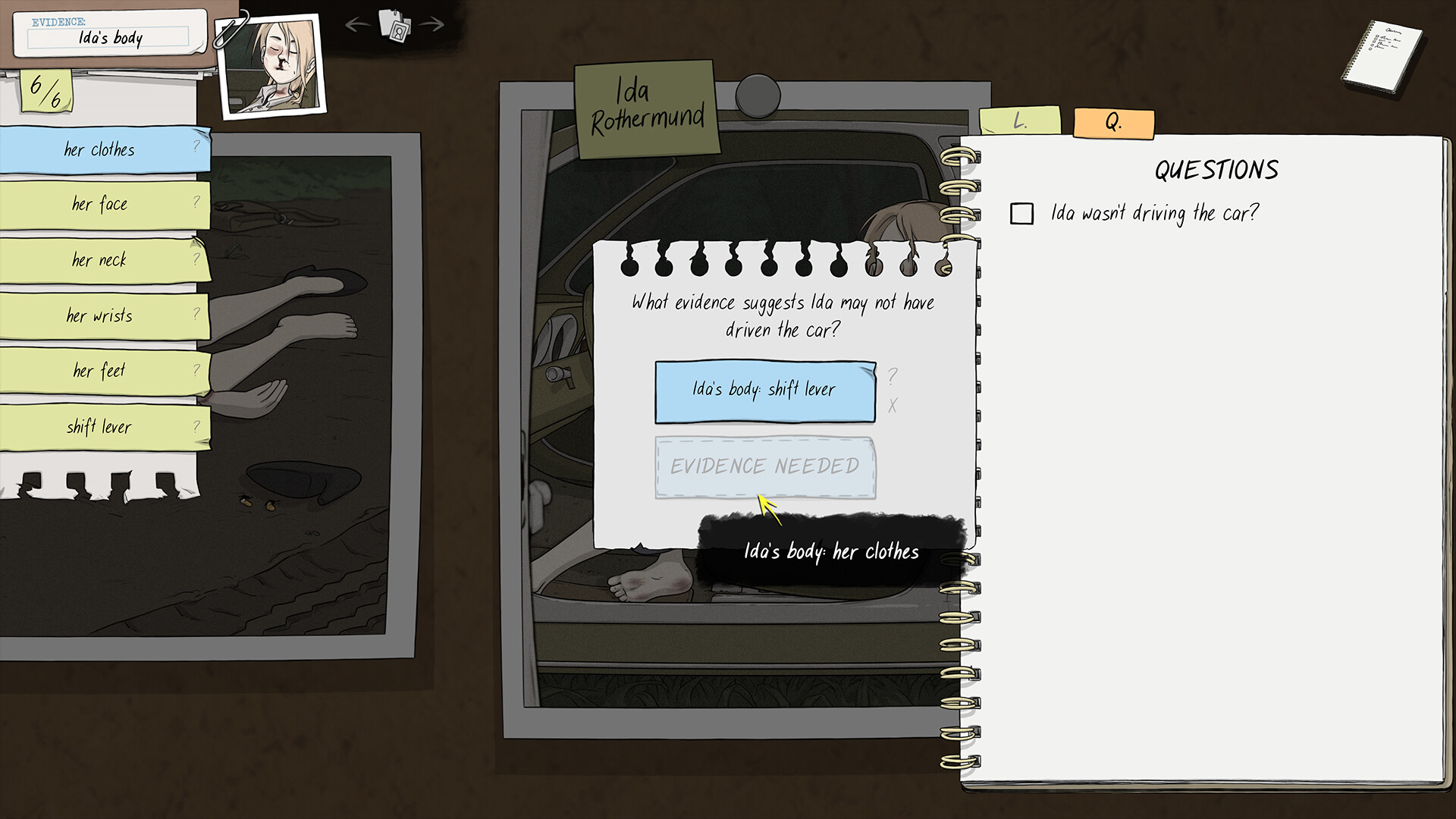
Before diving into the step-by-step solutions, you need to understand how The Big Hollow: 1982 expects you to think. The gameplay loop demands that you scan photographs, read witness statements, and compile a bank of over 75 pieces of evidence. When Lenore interrogates your theories, you must submit the exact combination of clues that answers the "why" behind the killer's actions. Early on, players found themselves frustrated, forced into brute-forcing combinations when their logic didn't perfectly align with the developer's intent.
Thankfully, Krams Design listened to the community. The recent v1.1.10 update added a much-needed, elegant hint system. If you fail a deduction twice, you can now click the "?" button to ask Lenore for guidance. Her hints are designed to gently steer you toward the correct behavioral pattern without spoiling the "aha" moment. Furthermore, the game now recognizes "close, but not quite" answers, providing additional dialogue that explains why your current train of thought is flawed.
Walkthrough Phase 1: The Truck Stop Disappearances
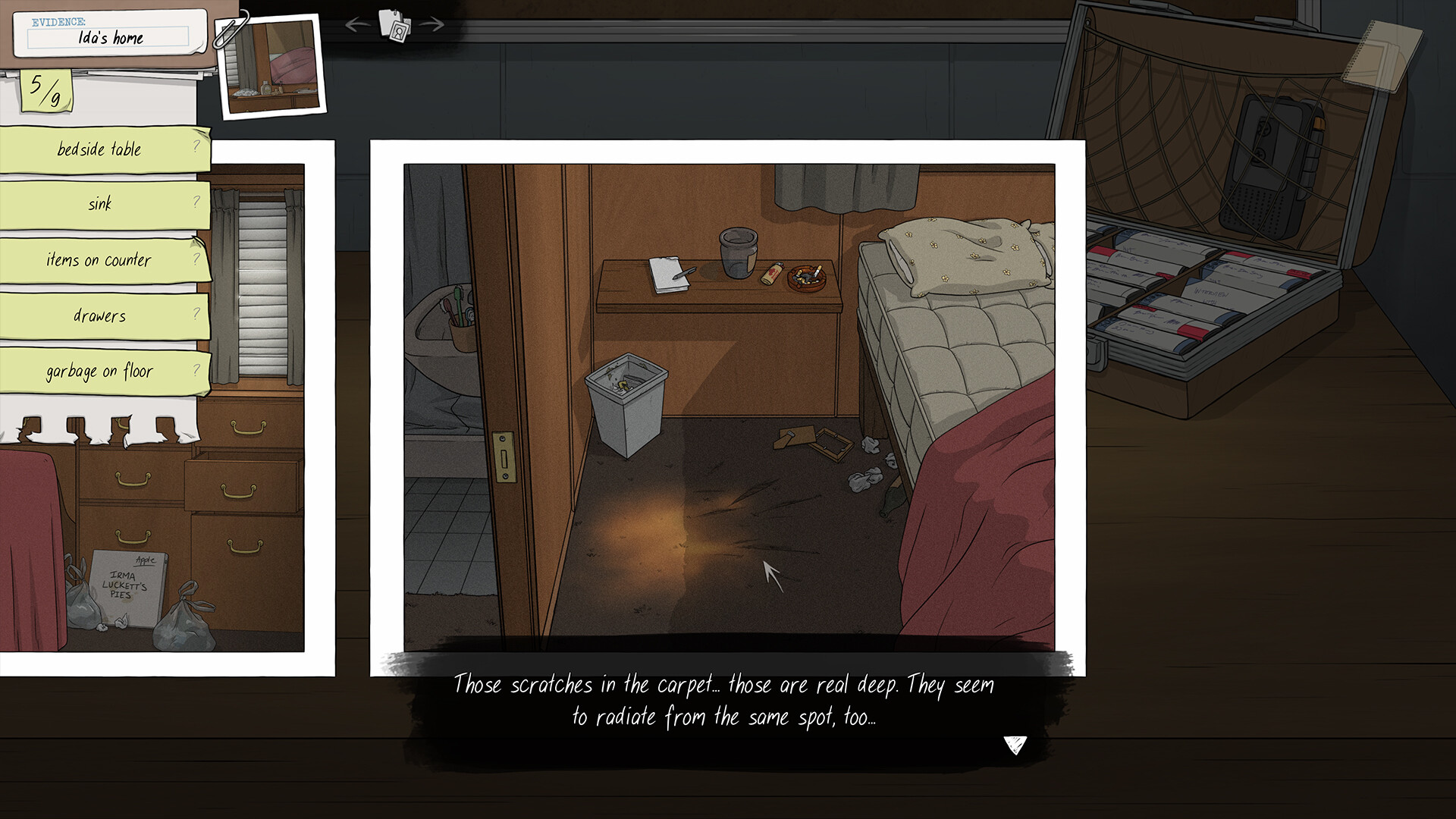
The core mystery spans a tight two-and-a-half to three hours. Your investigation begins at the local diner and the surrounding truck stop, attempting to retrace the final known movements of Ida and Bonnie. You will quickly identify a local named Dale as a person of interest.
The crucial early step is examining the photograph of the diner's back room. You need to investigate the shelf thoroughly. When you click on the jar, the internal thought text will update to reveal that "Dale was after it." This single observation establishes Dale's desperation and links him directly to Bonnie's last known location. Make sure you also log the muddy footprints by the loading dock and the torn shift schedule pinned to the breakroom board. When Lenore asks you to establish the initial timeline of the disappearances, you must present these three specific items to prove that the women didn't just walk away—they were intercepted during a highly specific window of opportunity.
Walkthrough Phase 2: The Fabricated Evidence
The mid-game is where The Big Hollow: 1982 pulls the rug out from under you. You will hit a narrative wall where the timeline simply does not make sense. This is not a bug; it is a deliberate test of your ability to recognize when a witness is lying to law enforcement.
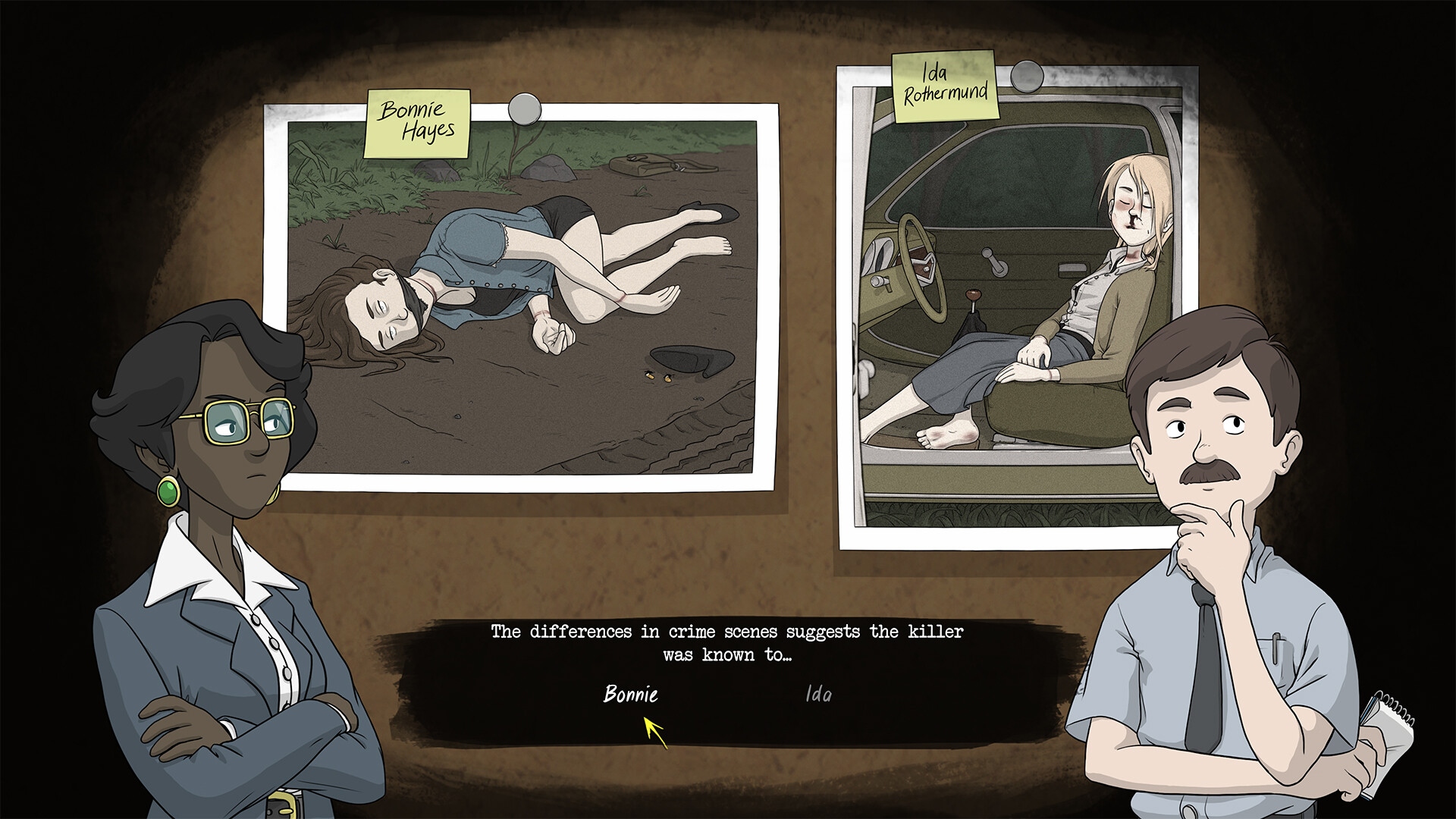
When Lenore asks you to finalize the sequence of events regarding the night of the storm, the solution hinges on a major piece of evidence being utterly false. Specifically, the alibi provided for the night of the storm is a total fabrication. You cannot solve this phase by taking the witness statements at face value. You must present the "Fake Alibi" alongside the "Weather Report" to prove the contradiction to Lenore. Doing so triggers the realization that this isn't a localized crime of passion—this shifts the case to a calculated, serial pattern. The killer is using the storm not just as cover, but as a mechanism to manipulate the local police's timeline.
The Ending Explained: Lenore’s Final Evaluation
The climax of The Big Hollow: 1982 isn't a dramatic shootout in a warehouse; it is a quiet, suffocating conversation in a sterile interrogation room. In the final act, you must synthesize the true timeline and present the killer's psychological profile. You aren't just naming the culprit; you are explaining why they chose Ida and Bonnie. The killer viewed the truck stop as a hunting ground, exploiting the transient nature of the community to ensure the victims wouldn't be immediately missed.
Depending on how many mistakes you made throughout the 3-hour runtime, Lenore will evaluate your performance. If you fail the final, complex deduction, the game does something incredibly rare: it lets you lose. You are presented with a stark choice. You can ask to hear the real explanation from Lenore, you can try again to solve it correctly, or you can skip the breakdown entirely and accept your failure.
If you choose to hear the real explanation, Lenore breaks down how the killer's motive was rooted in a pathetic need for control over women who were attempting to leave the town. The fabricated evidence was a deliberate plant by the killer to test the incompetence of the local police—a test you almost failed. If you struggled heavily, Lenore's closing dialogue is respectfully negative about your attempt. (Eagle-eyed players might notice a minor typo in the launch build here, where she tells Desmond he needs a "clearer self of self" rather than a "clearer sense of self"). She notes that the BSU requires a level of psychological fortitude that you have not yet demonstrated. It is a sobering ending that reinforces the game’s core thesis: profiling is an inexact, psychologically taxing science, and not everyone is cut out for it.
The Closing Take
The Big Hollow: 1982 is a brave, demanding piece of interactive fiction. By refusing to hold the player's hand and forcing them to confront their own flawed logic, Krams Design has created one of the most authentic detective experiences in recent memory. The revelation that you can simply fail the final exam and be professionally reprimanded by your superior is a refreshing departure from games that mandate victory regardless of player skill. It is a cold, haunting look at the origins of criminal profiling, and a mandatory play for anyone who thinks they have what it takes to map a monster.